Deal Soldier Field Intelligence
Deal Alerts vs Deal Judgment
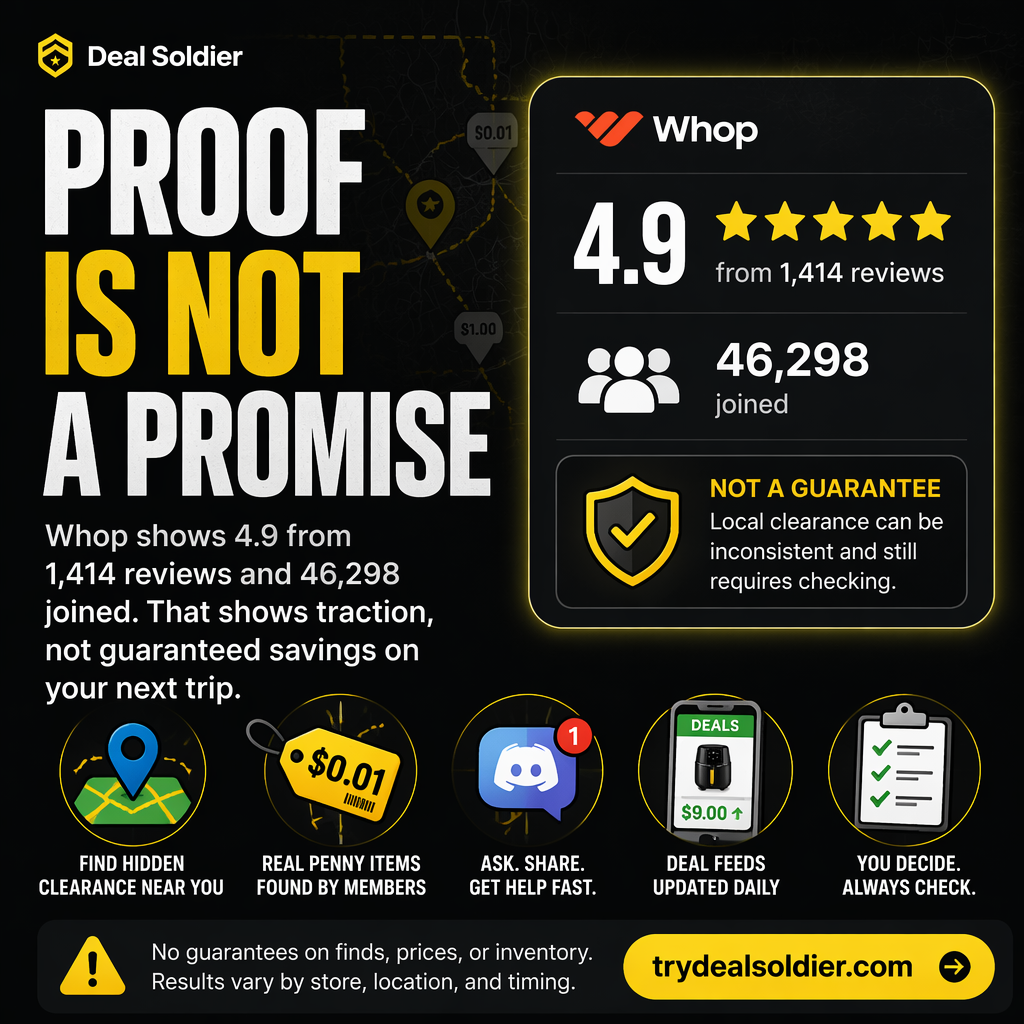
If you are fighting alert addiction, use this operational test: the wrong alert costs more than no alert because it creates motion without judgment
Start the Deal Soldier 7-day trial on Whop
The Field Investigation: What We Are Actually Testing
If you are investigating Deal Soldier, you have likely seen viral social clips: shopping carts loaded with $25 laptops, $3 designer rugs, and penny clearance finds in big-box stores. But viral posts skip the operational friction: store inventory algorithms, shelf tagging lag, phantom stock, and the reality of resale fees.
The core trap we are deconstructing in this guide is alert addiction. The operational rule of thumb is straightforward: the wrong alert costs more than no alert because it creates motion without judgment. If you cannot establish a systematic local workflow that produces verified savings during your 7-day free trial, you should cancel immediately on Whop.
Below is our complete field investigation for Deal Alerts vs Deal Judgment, broken down scene-by-scene into store mechanics, algorithm breakdowns, and actionable testing protocols.
Alerts Feel Like Edge
There is an intoxicating sensation that comes with subscribing to real-time deal alerts. Your phone buzzes twenty times an hour with automated notifications: clearance drops, glitch prices, inventory updates, and markdown sweeps across major national retailers.
This constant stream of notifications creates a false sense of competency. You feel informed, connected, and ahead of the curve. You tell yourself that because you saw the alert the minute it dropped, you possess an insurmountable edge over ordinary consumers.
In reality, an alert is simply raw data. It tells you that an event occurred in a computer database. It does not tell you if the item is physically on the shelf, whether it will sell in your local market, what your true net margin is after fees, or whether driving to that store makes economic sense. Without sharp operational judgment, alerts produce nothing but distraction and wasted fuel.
| Component | Deal Alert (Raw Data) | Deal Judgment (Human Edge) | Operational Outcome |
|---|---|---|---|
| Product Notice | Dewalt drill dropped to $39 | Does local market have stock? Will it flip for $90+? | Decides whether to turn on car ignition |
| Speed | Instantaneous automated ping | Calculated 60-second operational evaluation | Prevents impulsive driving on phantom stock |
| Value | Zero dollars on its own | The decision that creates net profit or saves cash | Turns software subscription into actual ROI |
📋 Actionable Verification Protocol
- Recognize that an alert is an invitation to investigate, not an order to buy.
- Take a mandatory 60-second pause after every interesting alert to run the numbers.
- Never leave your house on an alert ping without completing your verification check.
Target Decision: Rely on disciplined personal judgment rather than emotional notification hype.
Action Threshold: Filter out 90% of broadcast alerts as non-actionable for your specific situation.
Immediate Failure Mode: Mistaking high alert volume for real business productivity.
For additional context on Alerts Feel Like Edge, compare this operational step with our detailed breakdown in Deal Soldier vs Telegram Deal Groups and cross-reference our field rules in The Real Math Of Clearance Deals.
Why More Pings Make You Worse
Information theory demonstrates that beyond a certain threshold, increasing message volume degrades decision quality. In the clearance hunting world, this is known as 'Notification Paralysis'.
When you join Deal Soldier and enable notifications for all fifty channels—Walmart, Target, Home Depot, Lowe's, Penny Deals, Glitch Feeds, Resale Leads—your brain is bombarded with hundreds of stimulus pings daily. Each notification demands a micro-decision: 'Is this good? Should I look? Should I drive?'
By 2:00 PM, your cognitive reserves are exhausted. When a genuinely spectacular, highly profitable local deal actually drops, you either ignore it out of sensory fatigue, or you make a hasty, poorly calculated decision. The most profitable deal hunters ruthlessly mute 80% of channels and focus exclusively on 2 or 3 high-probability feeds.
| Notification Load | Daily Alert Volume | Hunter Psychological State | Decision Quality |
|---|---|---|---|
| Unfiltered Firehose (All Channels) | 150 - 300 pings / day | Exhausted, anxious, hyper-reactive | Terrible: Impulsive buys and missed gold |
| Moderate Filtering | 30 - 60 pings / day | Somewhat distracted; moderate focus | Average: Catches some wins, wastes some trips |
| Surgical Filtering (Targeted) | 5 - 12 pings / day | Calm, focused, highly disciplined | Exceptional: 80%+ execution hit rate |
📋 Actionable Verification Protocol
- Open your Discord notification settings and mute all channels except your primary 2 retailers.
- Disable general chat notifications; keep alerts enabled only for price drop bots.
- Schedule two specific times per day to review historical alert feeds rather than living on push pings.
Target Decision: Ruthlessly prune notification channels to preserve cognitive decision capital.
Action Threshold: Limit active push notification alerts to no more than 15 high-priority pings per day.
Immediate Failure Mode: Suffering notification burnout and quitting clearance hunting altogether.
For additional context on Why More Pings Make You Worse, compare this operational step with our detailed breakdown in SniperX And Turbo Search: What To Test First and cross-reference our field rules in Deal Soldier 7-Day Trial Checklist.
Freshness
In clearance hunting, information possesses a strict expiration curve. The value of a deal alert decays exponentially with every passing minute.
When an automated system like SniperX detects an 85% price drop on a premium tool kit at 7:00 AM, that information is pristine. If you are five minutes away, your probability of securing that inventory is near 100%.
However, other hunters, professional contractors, and store employees also walk those aisles. By 9:00 AM (two hours post-drop), probability falls to 40%. By 1:00 PM (six hours post-drop), probability drops below 5%. Evaluating 'alert freshness' before you touch your car keys is a mandatory operational habit.
| Alert Age | Shelf Survival Probability | Recommended Action | Driving Commitment |
|---|---|---|---|
| 0 - 30 Minutes | 85% - 95% likelihood of finding stock | Act immediately if close | Drive up to 15 minutes |
| 30 - 90 Minutes | 50% - 75% likelihood of finding stock | Verify stock count via Turbo Search first | Drive up to 10 minutes |
| 90 - 240 Minutes | 15% - 30% likelihood of finding stock | Check only if already in the immediate area | Do not make a dedicated trip |
| 4+ Hours / Previous Day | Under 5% likelihood (near zero) | Assume out of stock; do not drive | Zero travel commitment |
📋 Actionable Verification Protocol
- Always check the exact timestamp on an alert before looking at the product details.
- If an alert is more than two hours old, assume the items are gone unless verified in Turbo Search.
- Never make a dedicated cross-town drive for an alert that dropped earlier in the morning.
Target Decision: Incorporate alert age into your go/no-go driving decision matrix.
Action Threshold: Only launch dedicated trips for alerts less than 60 minutes old with 3+ units.
Immediate Failure Mode: Wasting time and fuel driving to stores for deals that were swept hours ago.
For additional context on Freshness, compare this operational step with our detailed breakdown in The Real Math Of Clearance Deals and cross-reference our field rules in Deal Soldier vs Telegram Deal Groups.
Locality
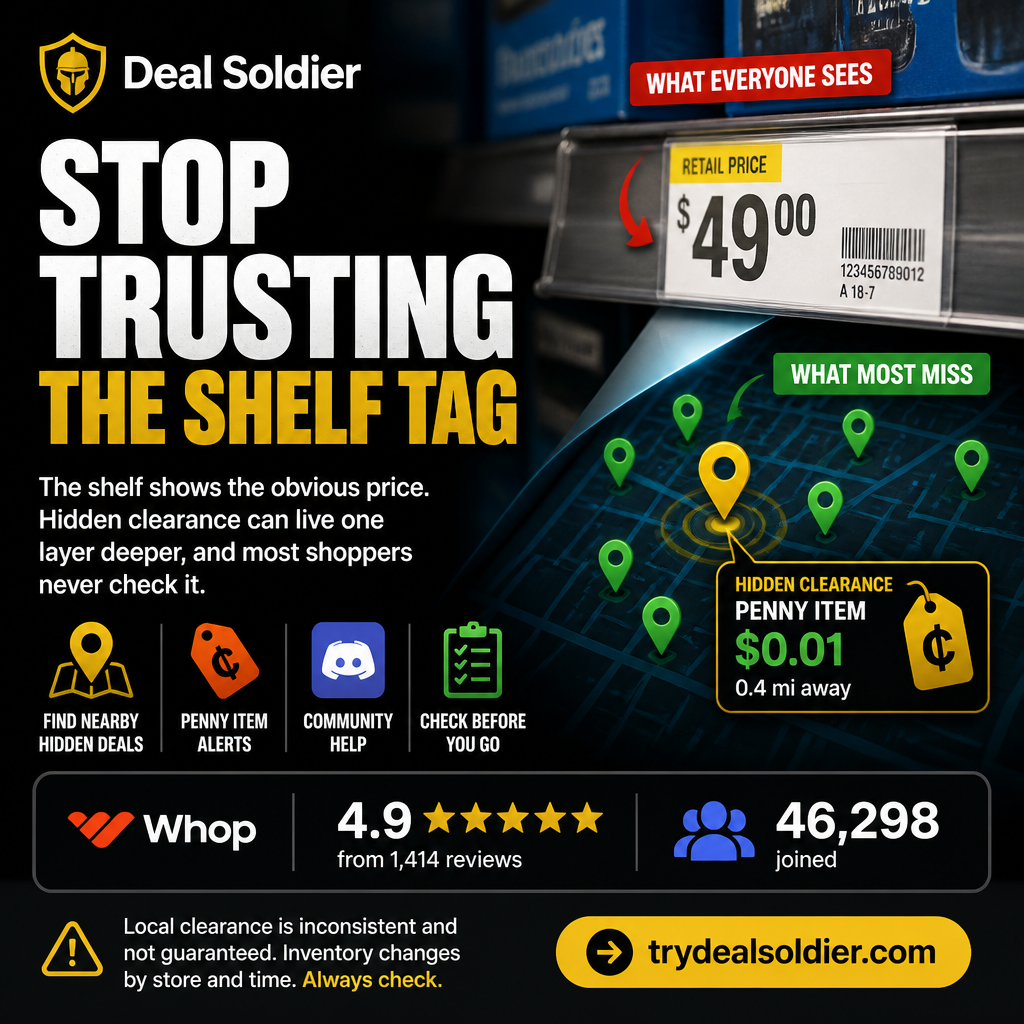
One of the primary reasons novice hunters fail to convert alerts into real cash is geographic delusion. They see a member post a receipt showing a $500 laptop purchased for $50 at a Walmart in rural Ohio, and they immediately rush to their local urban supercenter in Chicago expecting the exact same price.
This fails to account for store-level retail autonomy. Big-box chains empower store managers with localized markdown budgets to liquidate slow-moving or damaged goods. A store in Florida may liquidate winter coats in January at 90% off, while a store in Colorado keeps them at full price through March.
Deal judgment requires filtering all incoming information through a strict locality filter: Does this SKU drop apply to my specific store cluster? Has my local store manager activated the markdown? If the answer is unverified, do not drive.
| Deal Origin | Local Applicability | Validation Requirement | Action Protocol |
|---|---|---|---|
| National Corporate Rollback | Applies to 90%+ of stores nationwide | Verify on retailer public app | Safe to shop across all local stores |
| Regional Category Markdown | Applies to specific climate/metro zones | Check regional store IDs in Turbo Search | Target stores within designated zone |
| Store Manager Clearance | Applies ONLY to that single building | Direct in-store UPC scan required | Never drive to other stores expecting this price |
📋 Actionable Verification Protocol
- Establish your 'Hunting Radius': define the exact ZIP codes of stores within 15 minutes of your routes.
- Configure Turbo Search presets for your local store cluster.
- Ignore community brag posts from outside your geographic region unless verified locally.
Target Decision: Filter every deal alert through your local store cluster before taking action.
Action Threshold: Confirm local inventory and price in Turbo Search before traveling to any store.
Immediate Failure Mode: Chasing distant regional clearance drops that do not exist in your local market.
For additional context on Locality, compare this operational step with our detailed breakdown in Deal Soldier 7-Day Trial Checklist and cross-reference our field rules in SniperX And Turbo Search: What To Test First.
Math
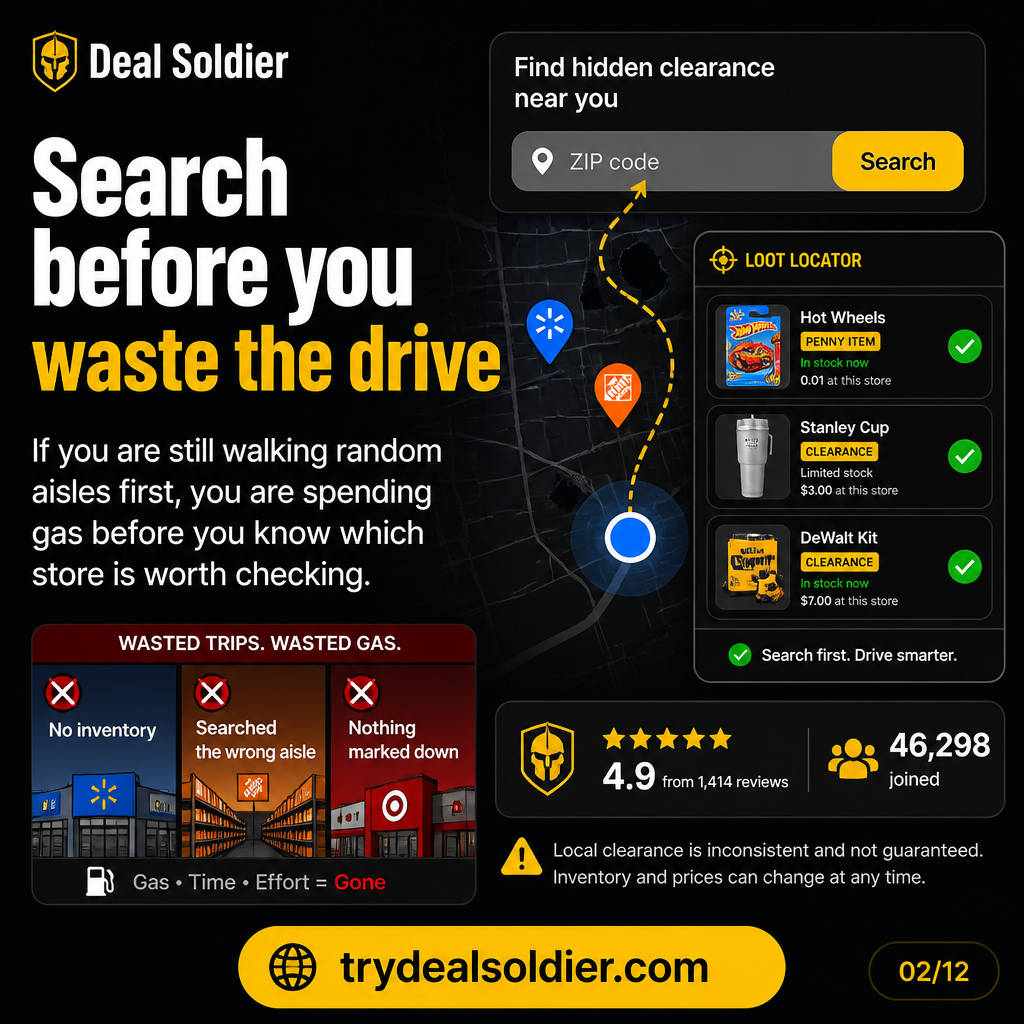
Once you arrive at a retail store, your psychology shifts. You have already invested time and gasoline; you feel an unconscious pressure to leave with merchandise so the trip doesn't feel 'wasted'.
This psychological trap—the Sunk Cost Fallacy—causes hunters to purchase marginal, low-profit clearance items that they would have rejected at home. To protect your capital, the financial math must be executed before you turn your car key.
The math filter takes less than a minute: 1. Confirm median secondary sold price. 2. Deduct 30% for platform fees and shipping. 3. Deduct retail purchase price plus local tax. 4. If the remaining net cash meets your Minimum Deal Threshold ($20+), grab your keys. If it doesn't, let someone else buy it.
| Step | Filter Action | Threshold Gate | Decision |
|---|---|---|---|
| 1. Resale Value | Check eBay 90-day sold median | Must have >= 3 sold comps in 30 days | Pass -> Move to Step 2 |
| 2. Friction Deduction | Deduct flat 30% for fees/freight | Ensure net proceeds cover COGS | Pass -> Move to Step 3 |
| 3. Net Cash Yield | Subtract buy price & tax from proceeds | Must yield >= $20 net profit per unit | Pass -> EXECUTE DRIVE |
| 4. Sub-Threshold | Net yield is under $15 | Fails minimum hourly hurdle rate | SKIP -> Stay home |
📋 Actionable Verification Protocol
- Run the 60-second math formula at your desk or kitchen table before leaving.
- Write down your target maximum purchase price on a piece of paper.
- If you arrive at the store and the price is higher than your math allowed, walk away.
Target Decision: Execute complete net margin calculations before committing travel time.
Action Threshold: Only leave your house for deals that mathematically clear your minimum profit hurdle.
Immediate Failure Mode: Driving to stores and making emotional purchases to justify wasted fuel.
For additional context on Math, compare this operational step with our detailed breakdown in Deal Soldier vs Telegram Deal Groups and cross-reference our field rules in The Real Math Of Clearance Deals.
Category Fit
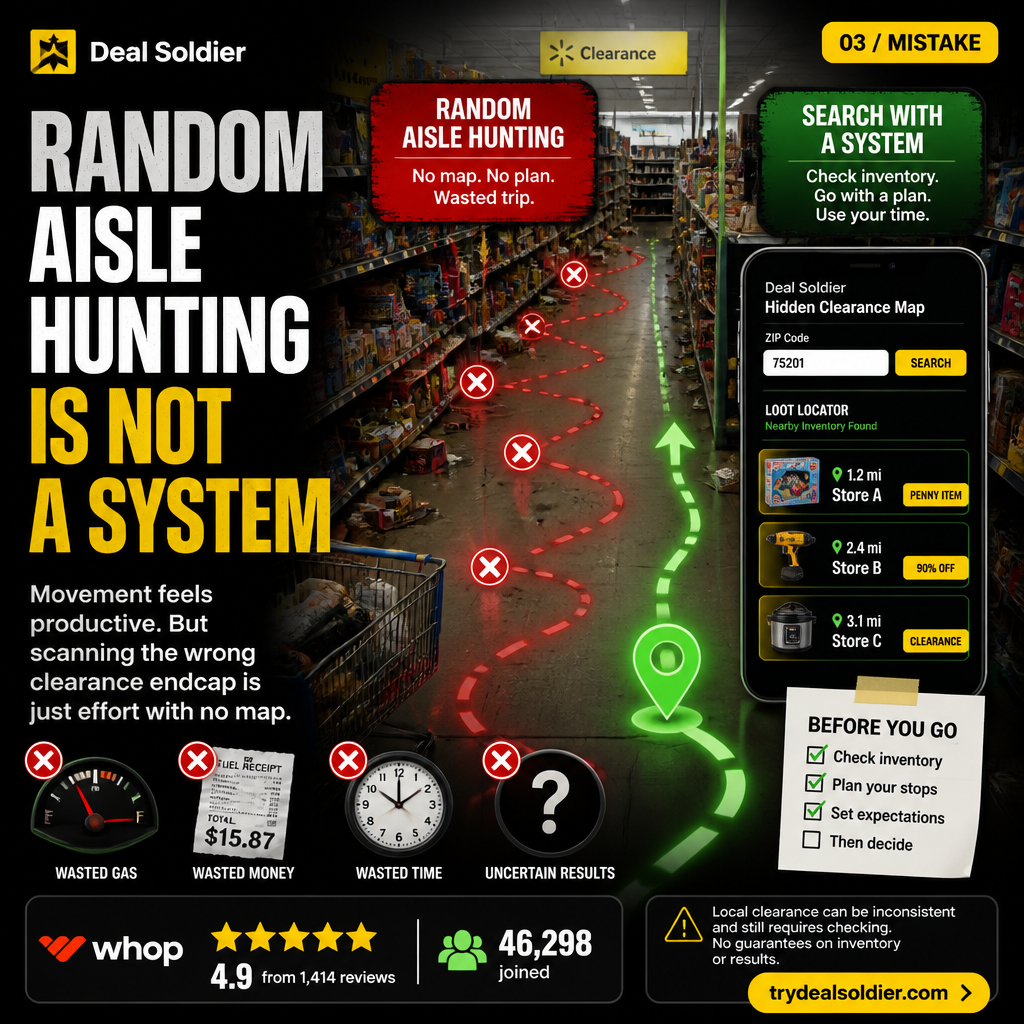
Deal judgment is deeply personal. What constitutes an incredible deal for a full-time contractor with an 8-foot truck bed and a commercial warehouse is an absolute nightmare for an apartment dweller with a compact car.
Consider physical logistics: If an alert pings for heavy patio sets, commercial tool chests, or riding lawnmowers at 80% off, you must have the physical means to transport, store, and ship those items. Attempting to force heavy freight into passenger sedans leads to damaged goods, scratched vehicle interiors, and domestic disputes.
Furthermore, consider category expertise. If you have zero knowledge of power tools, you won't recognize missing accessories or obsolete battery platforms. Focus your attention on 2 or 3 categories where you understand consumer demand, grading standards, and shipping requirements.
| Hunter Profile | Ideal Clearance Categories | Categories to Avoid | Logistical Fit |
|---|---|---|---|
| Apartment / Small Car | Consumer electronics, toys, smart home, small tools | Patio furniture, lawnmowers, bulky hardware | High dollar-to-size density |
| Homeowner / SUV | Cordless power tools, home goods, garden gear | Heavy building lumber, commercial equipment | Balanced cargo capacity |
| Full-Time Pro / Truck | Commercial hardware, patio sets, bulk pallet lots | Low-margin single small items | Bulk freight capacity |
📋 Actionable Verification Protocol
- Audit your physical constraints: measure your trunk cargo dimensions and designated home storage.
- Select your core 2-3 focus categories (e.g., Hand Tools & Seasonal Toys).
- Mute alerts for categories you cannot logistically transport or store.
Target Decision: Align your sourcing targets with your physical vehicle and storage capabilities.
Action Threshold: Only pursue items that you can safely transport in a single trip without vehicle damage.
Immediate Failure Mode: Buying bulky clearance items that won't fit in your vehicle or living space.
For additional context on Category Fit, compare this operational step with our detailed breakdown in SniperX And Turbo Search: What To Test First and cross-reference our field rules in Deal Soldier 7-Day Trial Checklist.
Action Threshold
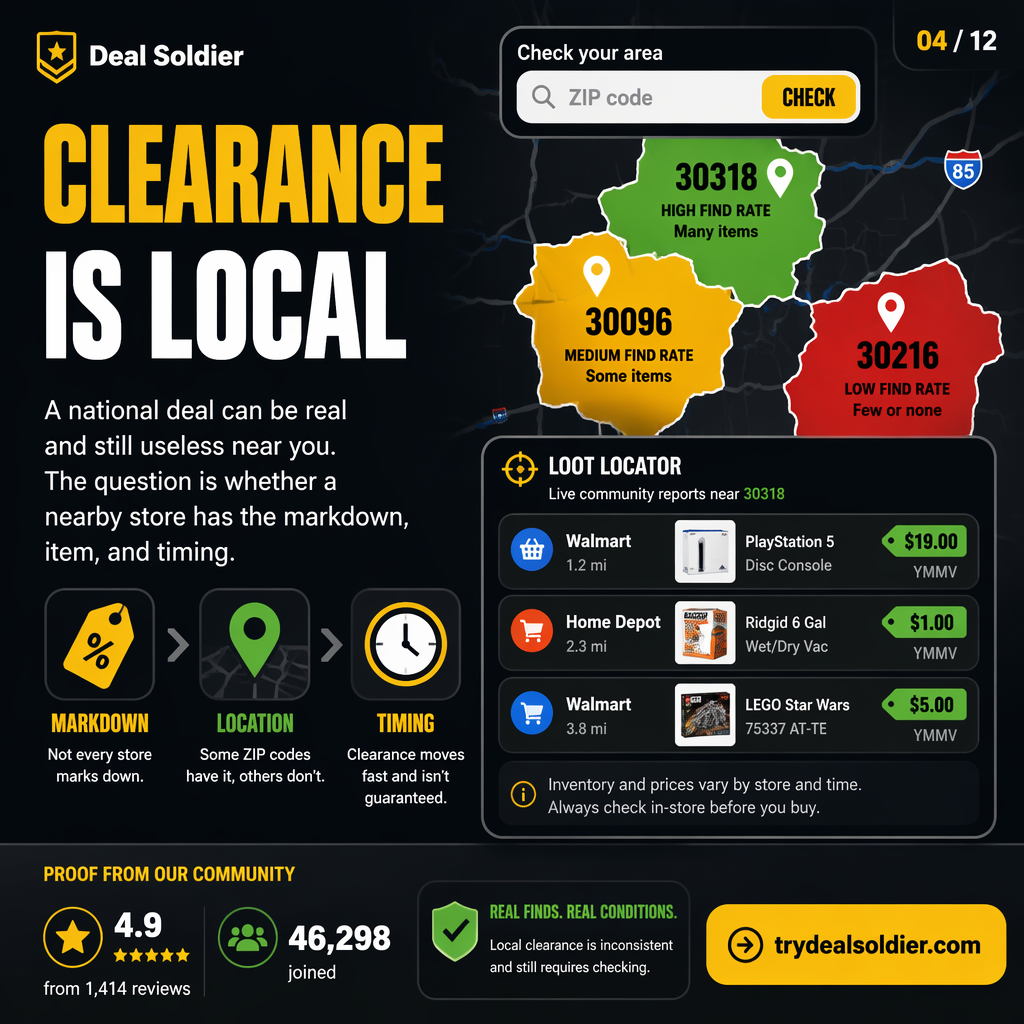
The final component of deal judgment is establishing an unambiguous Action Threshold. When an alert drops, you should never sit in agonizing indecision for twenty minutes wondering what to do.
Indecision is the enemy of execution. In the thirty minutes you spend debating whether a deal is 'good enough', another decisive hunter has already reviewed their criteria, driven to the store, and cleared the shelf.
Create a simple 4-Point Pre-Flight Checklist: 1. Alert Freshness (Under 45 mins). 2. Inventory Count (3+ units in local store). 3. Financial Net Return (Meets $20+ hurdle). 4. Logistical Capability (Fits in car and budget). If an opportunity scores 4 out of 4, you act immediately. If it scores 3 out of 4, you pass without regret.
| Checklist Gate | Pass Condition | Fail Condition | Impact on Action |
|---|---|---|---|
| Gate 1: Freshness | Alert timestamp < 45 minutes ago | Alert is 2+ hours old | Fail -> Immediate pass |
| Gate 2: Local Stock | 3+ units confirmed in local store ID | 1 unit (high phantom stock risk) | Fail -> Immediate pass |
| Gate 3: Profit Math | Expected net return >= $20 per unit | Net return is $8 - $12 | Fail -> Immediate pass |
| Gate 4: Logistics | Fits easily in vehicle; cash available | Too large for car; strains cash | Fail -> Immediate pass |
📋 Actionable Verification Protocol
- Memorize the 4-Point Pre-Flight Checklist: Freshness, Stock, Math, Logistics.
- Run through the checklist in under 30 seconds when an alert arrives.
- Commit 100% to the execution once all four gates pass.
Target Decision: Enforce an objective 4-point binary checklist for every potential deal trip.
Action Threshold: Execute the store trip only when all 4 gates achieve an unambiguous PASS.
Immediate Failure Mode: Wasting time in chronic indecision while competing hunters clear inventory.
For additional context on Action Threshold, compare this operational step with our detailed breakdown in The Real Math Of Clearance Deals and cross-reference our field rules in Deal Soldier vs Telegram Deal Groups.
How Deal Soldier Should Be Tested
When you activate your 7-day free trial of Deal Soldier on Whop, you are entering an evaluation window. The most ineffective thing you can do is treat that week like entertainment: casually reading member chat, admiring photos of other people's hauls, and letting the trial expire into a paid subscription without testing your own market.
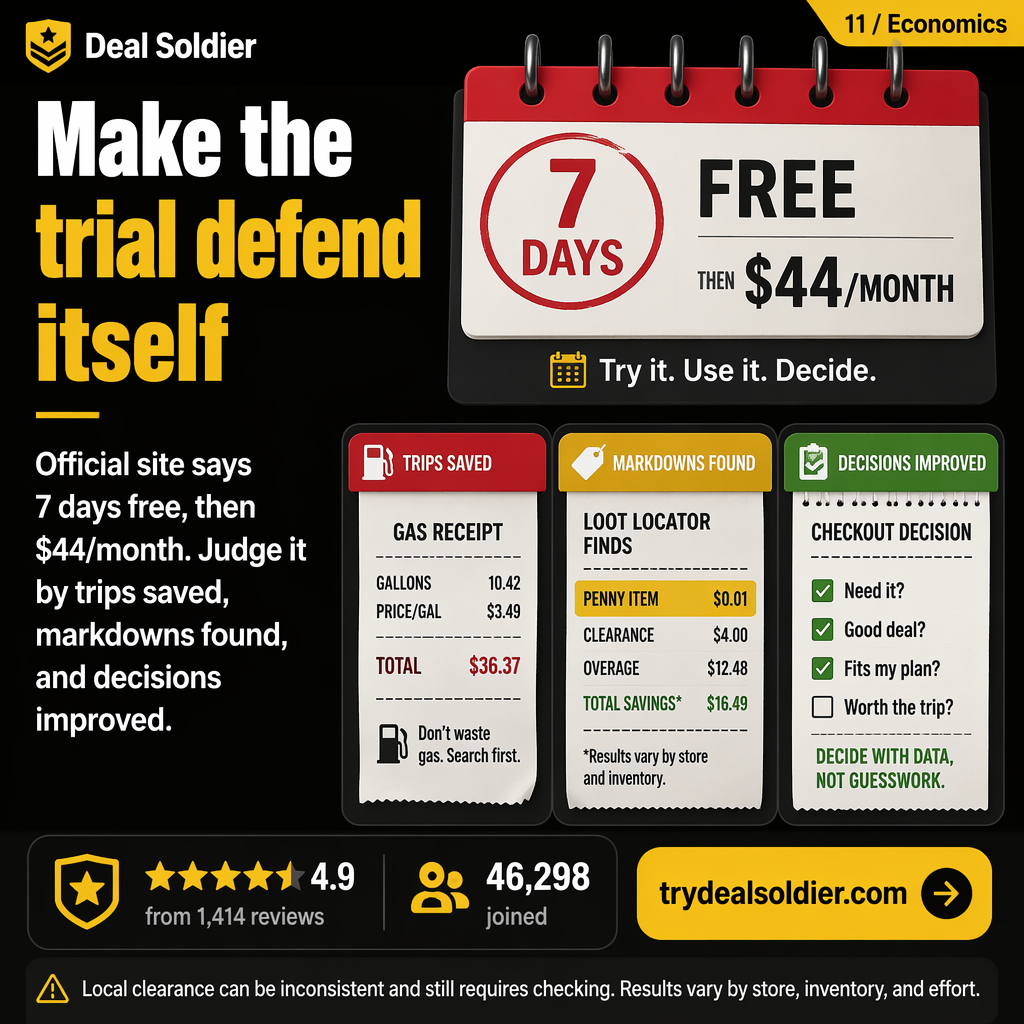
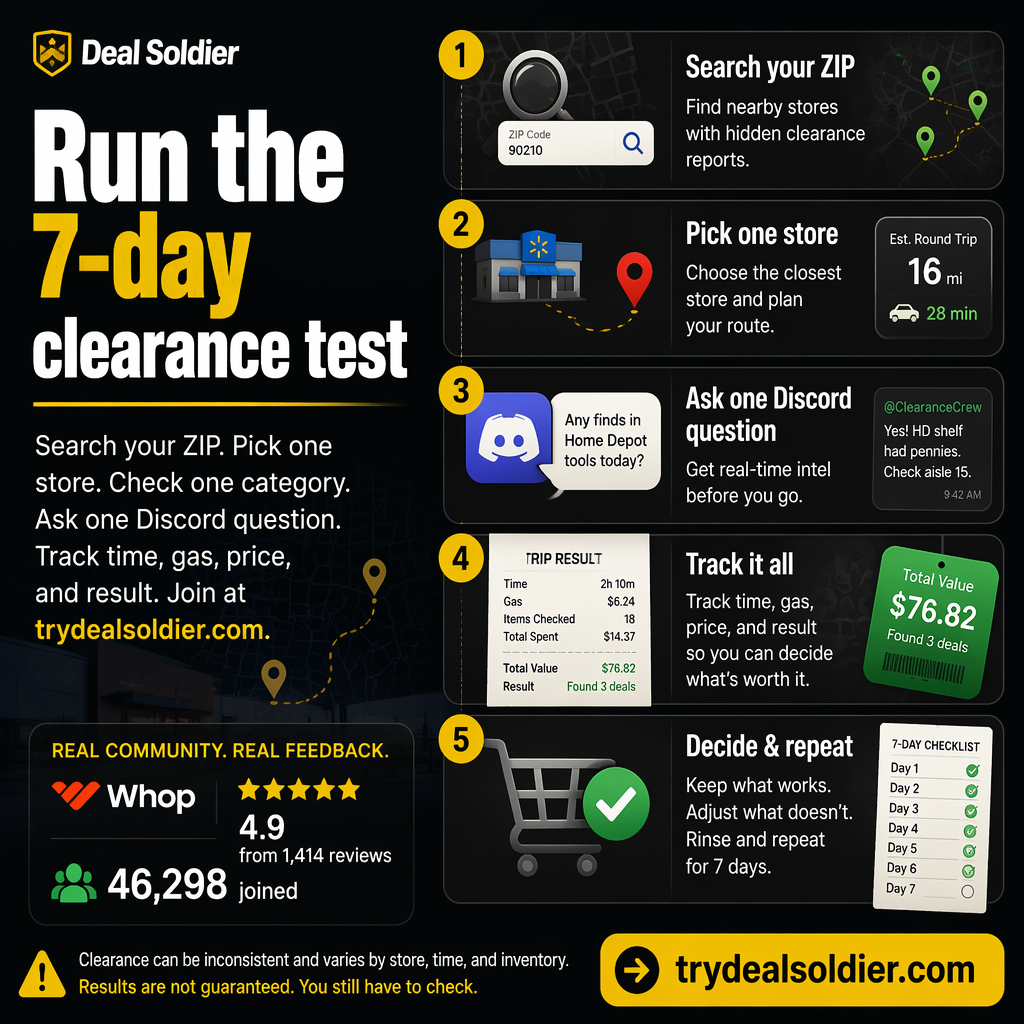
To know if Deal Soldier works for you, you must test it scientifically against your local retail environment. Configure your primary ZIP codes in Turbo Search. Set up SniperX notifications for your closest Walmart and Home Depot. Execute two physical store trips during your trial week.
At the end of Day 6, review your trial log. Did the tools guide you to verified unstickered clearance? Did you save or earn more than the $44 monthly fee? If yes, keep the subscription with complete confidence. If no, cancel inside Whop with one click. That is how professional consumers operate.
| Day | Testing Objective | Execution Task | Success Milestone |
|---|---|---|---|
| Day 1 - 2 | Software & Tool Setup | Configure ZIP presets in Turbo Search; mute noise channels | All local store IDs mapped in dashboard |
| Day 3 - 4 | Alert Audit & Scouting | Monitor SniperX feeds; compare with local store apps | Identify 2 high-probability local drops |
| Day 5 - 6 | Field Store Verification | Visit store; scan barcodes; execute purchase | Verify scanned POS price matches alert |
| Day 7 | Financial Scorecard | Calculate net trial ROI vs $44 fee | Decide: Renew or 1-Click Cancel on Whop |
📋 Actionable Verification Protocol
- Set a calendar reminder for Day 6 of your trial to evaluate your trial scorecard.
- Keep all receipts from trial-week store visits in a single envelope.
- Make your renewal decision based strictly on verified local results, not community hype.
Target Decision: Execute a structured 7-day field experiment before deciding on subscription renewal.
Action Threshold: Renew only if verified trial savings or profits exceed the $44 monthly fee.
Immediate Failure Mode: Allowing an untested subscription to renew automatically due to passive browsing.
For additional context on How Deal Soldier Should Be Tested, compare this operational step with our detailed breakdown in Deal Soldier 7-Day Trial Checklist and cross-reference our field rules in SniperX And Turbo Search: What To Test First.
FAQ
Mastering the balance between real-time deal alerts and personal operational judgment is the defining milestone in a clearance hunter's journey.
First: What should you do when you miss an alert? Absolutely nothing. The clearance market is continuous; retailers push thousands of markdowns every single week. Missing an alert is completely irrelevant. Never chase an expired deal out of FOMO (Fear Of Missing Out). The next opportunity is already loading into the retail database.
Second: How much time should you commit weekly? Successful part-time hunters spend only 2 to 4 hours per week on physical store visits, integrated into their existing daily travel routines. By using Deal Soldier to eliminate blind trips, you turn occasional grocery or home improvement runs into high-margin treasure hunts.
| Question | Operational Reality | Best Practice |
|---|---|---|
| How do I handle missed deals? | Deals are continuous; missing one is irrelevant | Never chase expired alerts; wait for the next wave |
| How much time is required? | 2 to 4 hours weekly when paired with normal commutes | Combine store visits with grocery & errand routes |
| What if a store employee is rude? | Retail associates face heavy workloads and stress | Remain polite, use self-checkout, and move on |
| Can I cancel if my area has poor deals? | Whop provides transparent 1-click trial cancellation | Cancel inside your Whop dashboard before Day 7 |
📋 Actionable Verification Protocol
- Integrate store scanning into your existing weekly routine rather than making special trips.
- Maintain emotional detachment: treat clearance hunting as a calm numbers game.
- Use Whop's dashboard to manage your subscription with complete transparency.
Target Decision: Develop calm, disciplined execution habits to achieve consistent long-term results.
Action Threshold: Focus on repeatable processes rather than chasing one-off viral hauls.
Immediate Failure Mode: Letting FOMO drive reckless travel decisions and burn out your enthusiasm.
For additional context on FAQ, compare this operational step with our detailed breakdown in Deal Soldier vs Telegram Deal Groups and cross-reference our field rules in The Real Math Of Clearance Deals.