
Deal Soldier Field Intelligence
The Real Math Of Clearance Deals
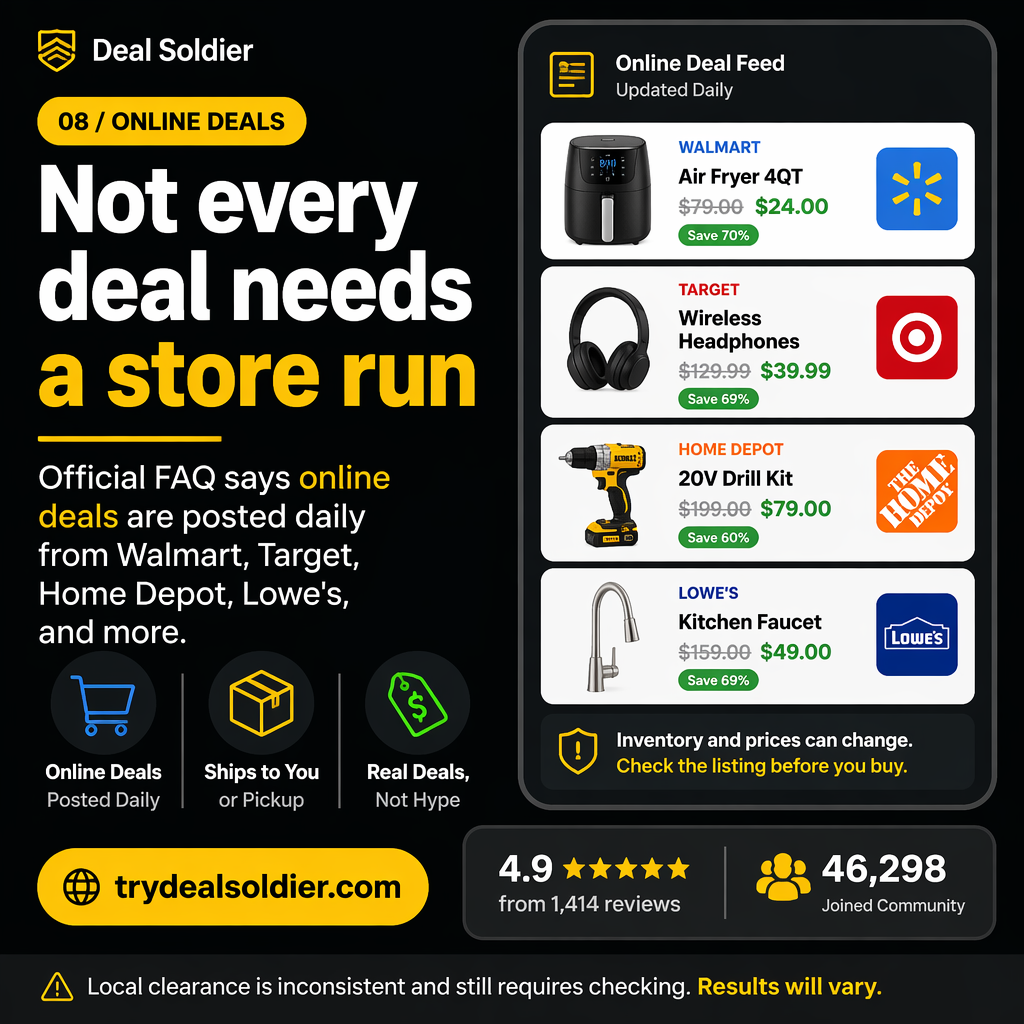
If you are fighting discount percentage worship, use this operational test: a 90 percent discount can still lose if fees, time, and demand erase the spread
Start the Deal Soldier 7-day trial on Whop
The Field Investigation: What We Are Actually Testing
If you are investigating Deal Soldier, you have likely seen viral social clips: shopping carts loaded with $25 laptops, $3 designer rugs, and penny clearance finds in big-box stores. But viral posts skip the operational friction: store inventory algorithms, shelf tagging lag, phantom stock, and the reality of resale fees.
The core trap we are deconstructing in this guide is discount percentage worship. The operational rule of thumb is straightforward: a 90 percent discount can still lose if fees, time, and demand erase the spread. If you cannot establish a systematic local workflow that produces verified savings during your 7-day free trial, you should cancel immediately on Whop.
Below is our complete field investigation for The Real Math Of Clearance Deals, broken down scene-by-scene into store mechanics, algorithm breakdowns, and actionable testing protocols.
Discount Is Not Profit
The single most dangerous mental trap in retail clearance is equating percentage discount with net cash profit. When you see a yellow tag reading 'Was $200, Now $40', your brain perceives a $160 windfall.
However, retailers set MSRPs (Manufacturer's Suggested Retail Prices) arbitrarily, and an item on clearance is often there precisely because nobody was willing to pay that MSRP. If consumer demand on eBay, Mercari, or Facebook Marketplace has established the true market value at $65, buying it at $40 does not leave you with a $160 profit—it leaves you with a catastrophic financial loss after shipping and fees.
Professional clearance hunters operate on net realized margin rather than gross percentage discount. You do not deposit percentages into your bank account; you deposit net dollars after all operational deductions.
| Metric | Novice Assumption | Professional Reality | Financial Consequence |
|---|---|---|---|
| Baseline Value | Original MSRP ($200.00) | Current 90-day eBay Sold Average ($75.00) | Overestimating resale value by 166% |
| Gross Discount | 80% Off ($160.00 'saved') | Irrelevant historical manufacturer anchor | Creates false confidence to overbuy |
| All-In Expenses | Ignored ($0.00) | Fees ($9.94) + Shipping ($18.50) + Tax ($3.30) | $31.74 in hidden operational friction |
| Net Cash In Pocket | Expected +$160.00 | Realized +$3.26 net cash | Hourly labor yields pennies; inventory risk |
📋 Actionable Verification Protocol
- Never calculate profit using the retailer's original 'Was' price tag.
- Open eBay, search the exact model number, filter by 'Sold Items', and take the median price.
- Deduct 30% from the median sold price for fees, packaging, and shipping before buying.
Target Decision: Base every buy decision on verified secondary market sold comps, never retail MSRP.
Action Threshold: Require an expected net profit of at least $20 per unit and 30% net margin.
Immediate Failure Mode: Buying low-demand clearance based on high MSRP discounts and trapping cash in dead stock.
For additional context on Discount Is Not Profit, compare this operational step with our detailed breakdown in Should You Flip That Clearance Find? and cross-reference our field rules in Walmart Hidden Clearance Guide.
Personal Savings Math
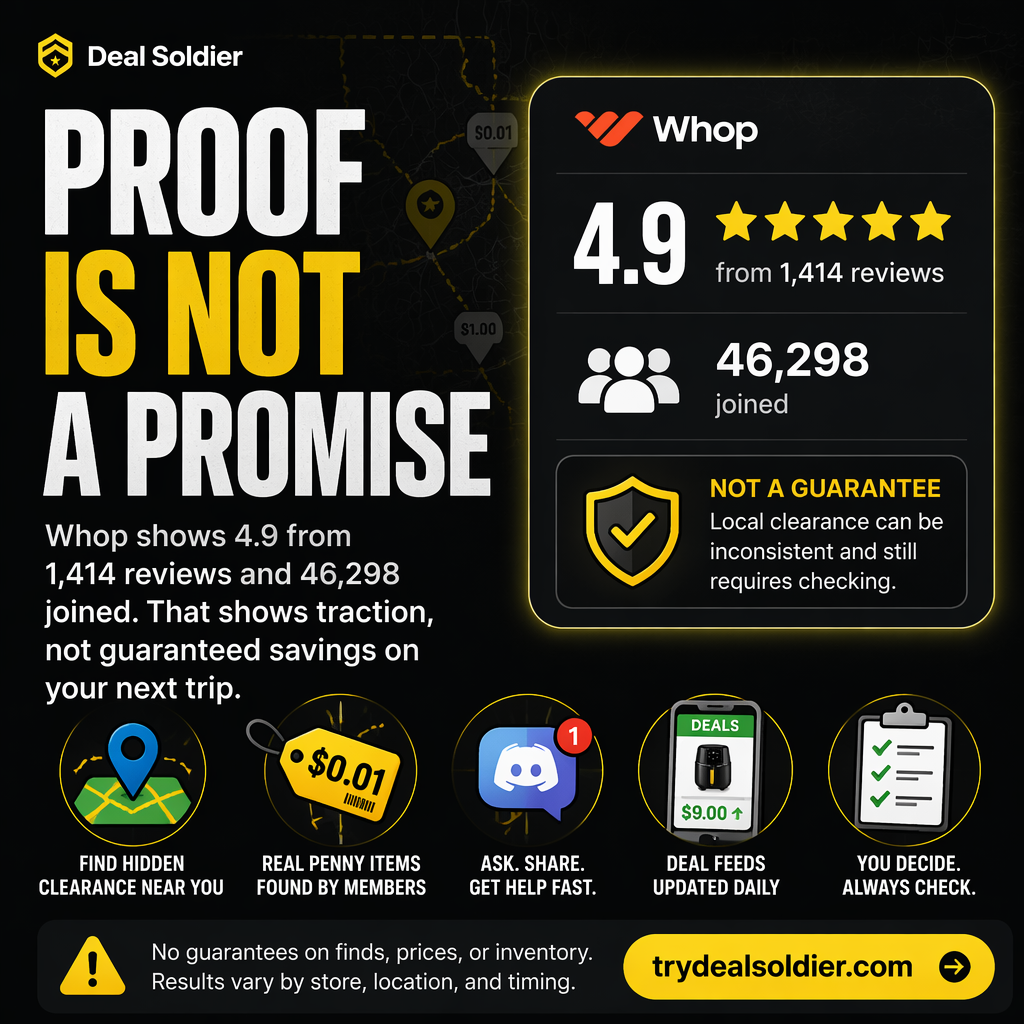
While resale receives most of the viral attention, the cleanest, highest-ROI application of Deal Soldier is personal household procurement. When you buy an item for personal use, the economic equation is completely different from resale.
In resale, every dollar of gross margin is eroded by platform commissions, payment processing fees, shipping costs, and income taxes. In personal consumption, every dollar saved is a pure, post-tax net dollar kept in your household budget.
For example, a homeowner replacing lawn care equipment, power tools, home filtration systems, or seasonal patio furniture routinely spends $1,000 to $2,500 annually. By using Deal Soldier's Turbo Search to time these purchases during clearance transitions, households save $500 to $1,500 per year—recouping the $44 monthly fee many times over without ever listing a single package online.
| Category | Annual Retail Budget | Clearance Cost via Deal Soldier | Net Household Savings |
|---|---|---|---|
| Power & Hand Tools (DIY) | $400.00 | $120.00 (60-70% off markdowns) | +$280.00 tax-free savings |
| Lawn & Garden Supplies | $350.00 | $95.00 (end-of-season purges) | +$255.00 tax-free savings |
| Home Goods & Cookware | $300.00 | $85.00 (store reset transitions) | +$215.00 tax-free savings |
| Holiday & Seasonal Goods | $450.00 | $110.00 (post-holiday 75-90% off) | +$340.00 tax-free savings |
📋 Actionable Verification Protocol
- Create a list of upcoming major household purchases planned for the next 6 months.
- Set alert keywords in Deal Soldier for those specific brands and categories.
- Purchase when clearance drops hit 60%+ without taking on any resale inventory risk.
Target Decision: Target high-ticket household necessities to generate guaranteed risk-free ROI.
Action Threshold: Only buy clearance items you had already planned or budgeted to purchase.
Immediate Failure Mode: Buying unneeded consumer junk just because it has a steep discount sticker.
For additional context on Personal Savings Math, compare this operational step with our detailed breakdown in Is Deal Soldier Good For Resellers? and cross-reference our field rules in Home Depot Penny Deals: Signal Or Time Sink?.
Reseller Net Math
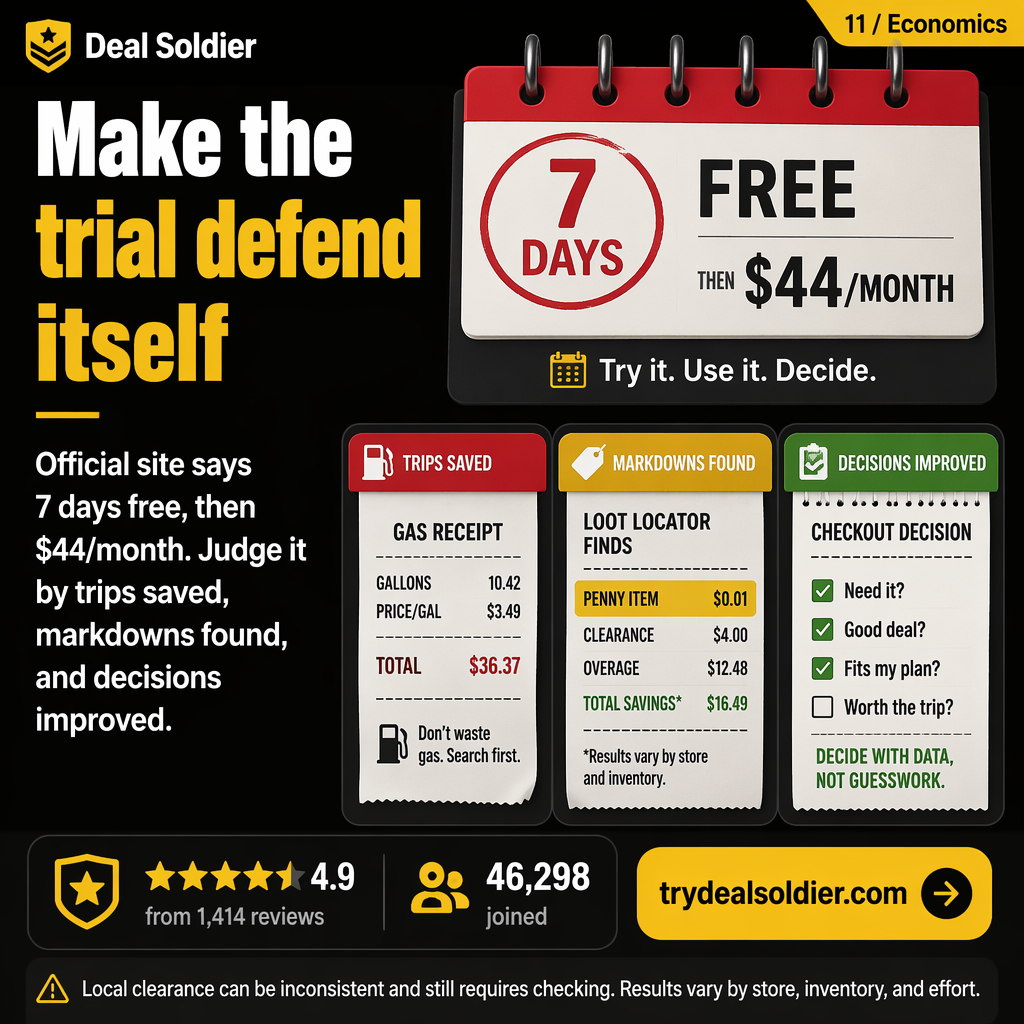
In retail arbitrage, beginners look at the spread between purchase price and selling price and assume the difference is profit. This naive calculation is why so many novice resellers burn out within ninety days.
Every physical transaction carries a gauntlet of mandatory deductions. First is local sales tax paid at the retail register (typically 6% to 9%). Next is marketplace final value fees (eBay averages 13.25% + $0.30; Amazon averages 15%). Then comes payment processing, outbound carrier shipping, and packaging materials (boxes, dunnage, thermal labels).
Finally, you must reserve capital for customer returns and calculate federal/state self-employment taxes. When you subject that '$50 profit' to real-world friction, your true net cash return shrinks dramatically. Understanding this math is the foundation of professional sourcing.
| Transaction Component | Gross Sale: $100.00 Item | Percentage of Sale | Cumulative Net Left |
|---|---|---|---|
| Purchase Price (Clearance) | -$50.00 | 50.0% | $50.00 remaining |
| Local Sales Tax Paid (7%) | -$3.50 | 3.5% | $46.50 remaining |
| Marketplace Fee (eBay 13.25%+$0.30) | -$13.55 | 13.6% | $32.95 remaining |
| Shipping & Box / Packaging | -$12.50 | 12.5% | $20.45 remaining |
| Return Reserve & Damage (4%) | -$4.00 | 4.0% | $16.45 REAL NET PROFIT |
📋 Actionable Verification Protocol
- Input every prospective purchase into a net profit calculator before walking to the register.
- Ensure your projected net profit is at least 3x the cost of inbound shipping.
- Track all packaging expenses (boxes, bubble wrap, tape) as direct cost-of-goods deductions.
Target Decision: Require a minimum 2.5x to 3x markup on clearance items before buying for resale.
Action Threshold: Buy at <= $30 if expected resale price is $100 to ensure a viable net return.
Immediate Failure Mode: Sourcing on thin gross margins that turn negative the moment a buyer requests a return.
For additional context on Reseller Net Math, compare this operational step with our detailed breakdown in Walmart Hidden Clearance Guide and cross-reference our field rules in Should You Flip That Clearance Find?.
Fees
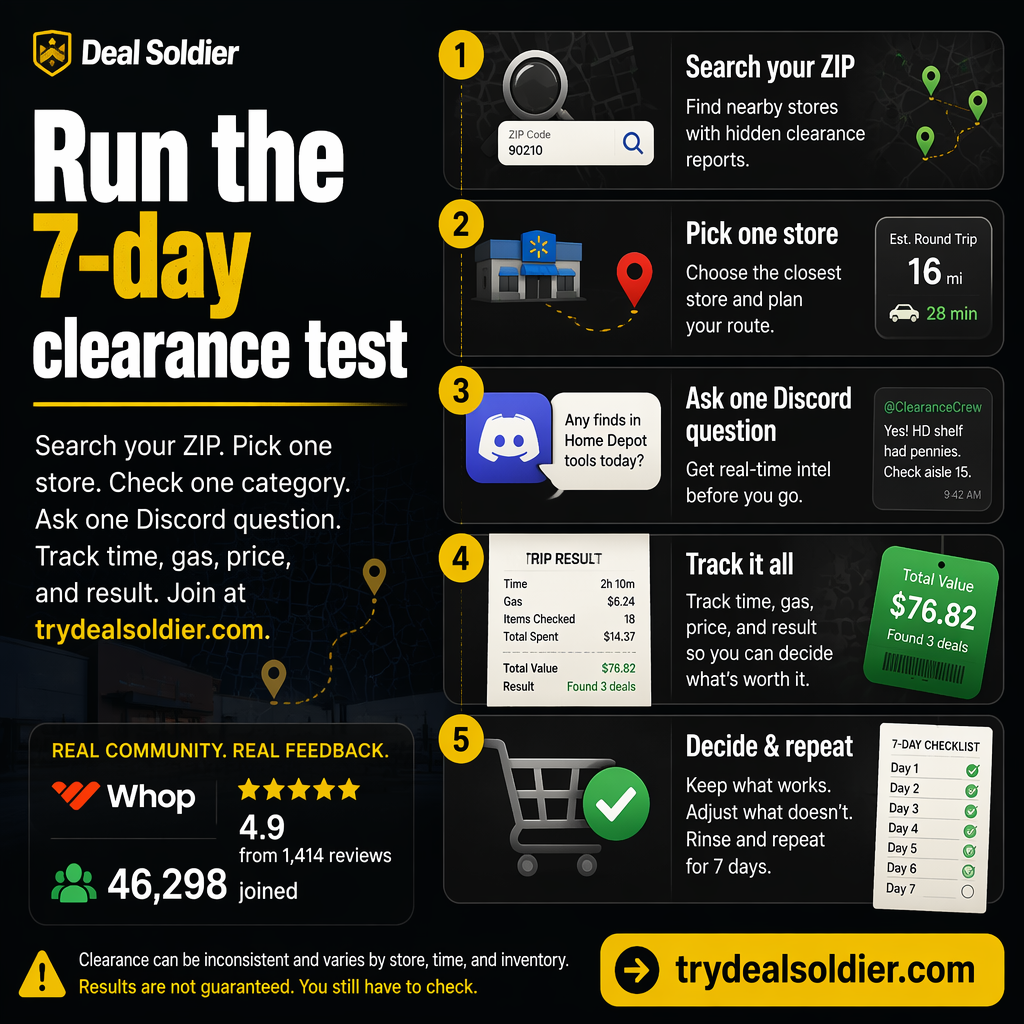
When calculating resale margins on clearance finds, you must know the exact fee schedule of your intended sales channel. Selling fees are deducted from the total transaction amount—including the shipping cost paid by the buyer and sales tax.
On eBay, the standard final value fee for most consumer categories is 13.25% plus $0.30 per order. If you utilize Promoted Listings Standard to maintain competitive search placement, expect an additional 4% to 8% ad fee, pushing your total platform cut past 18%.
On Amazon FBA (Fulfillment by Amazon), referral fees average 15%, plus fixed fulfillment and storage fees that easily consume 25% to 35% of an item's selling price on heavier goods. On local platforms like Facebook Marketplace or OfferUp, platform fees are 0% for cash pickup, but you trade fees for the time cost of managing no-show buyers.
| Sales Channel | Platform Base Fee | Promoted / Extra Fees | Effective Total Fee Take |
|---|---|---|---|
| eBay Standard | 13.25% + $0.30 per order | 3% - 7% Promoted Listings | 16.0% - 20.5% of total paid |
| Amazon FBA | 15.0% referral fee | FBA pick/pack + monthly storage | 25.0% - 38.0% of retail price |
| Mercari | 10.0% seller fee + 2.9% payment | Optional buyer promotion fees | 12.9% - 15.0% of total |
| Facebook Marketplace (Local) | 0.0% (cash on collection) | Fuel & time managing messages | 0% monetary fee; high time cost |
📋 Actionable Verification Protocol
- Calculate fees on the total buyer payment (Item Price + Buyer Shipping + Estimated Tax).
- Include promoted listing percentages when competing in saturated electronics categories.
- Choose local pickup platforms for heavy, bulky clearance items to eliminate all shipping fees.
Target Decision: Match each clearance item to the platform with the lowest fee-to-speed friction.
Action Threshold: Deduct a flat 18% for platform fees when evaluating eBay flips on your phone.
Immediate Failure Mode: Calculating fees only on the item price, ignoring that platforms take fees on shipping too.
For additional context on Fees, compare this operational step with our detailed breakdown in Home Depot Penny Deals: Signal Or Time Sink? and cross-reference our field rules in Is Deal Soldier Good For Resellers?.
Gas
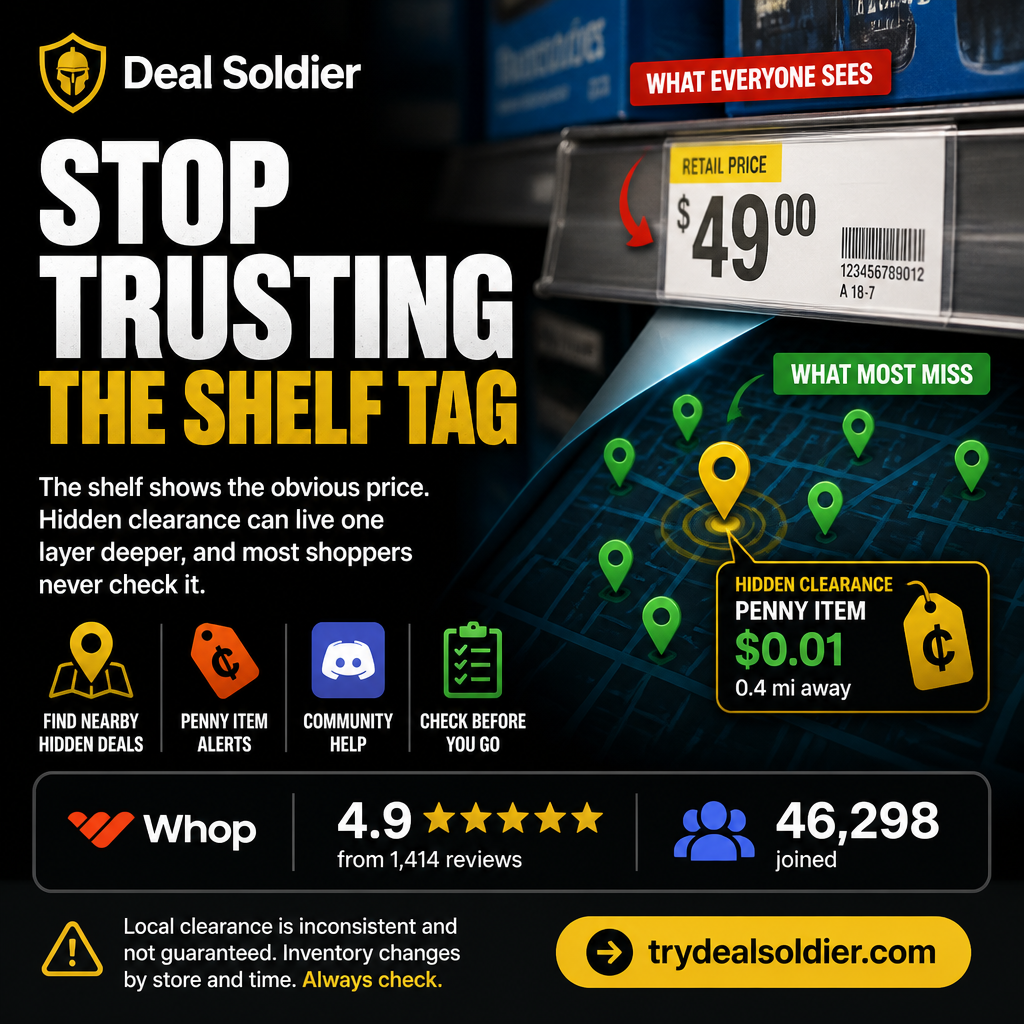
Vehicle expense is the silent profit killer in retail arbitrage. Beginners mentally account for the price paid at the register, but completely ignore the trip cost of getting to the store and back.
According to standard automotive accounting (and IRS business mileage rates), driving a personal vehicle costs approximately $0.60+ per mile when factoring in gasoline, oil, tire wear, brake pads, and vehicle depreciation. Even calculating only direct fuel expense in a standard crossover or truck, you are burning $0.15 to $0.25 per mile.
If you embark on a 30-mile round trip to buy two clearance coffee makers that yield $8 profit each ($16 total), your fuel and vehicle wear cost approximately $18. You spent two hours of your time and actually lost $2. Deal Soldier's Turbo Search solves this by allowing you to pre-screen stores and only drive when high-margin multi-unit inventory is verified.
| Trip Distance | Direct Fuel Expense (at 22 MPG) | IRS Real Operating Cost ($0.67/mi) | Minimum Haul Profit Required |
|---|---|---|---|
| 10-Mile Local Round Trip | $1.60 | $6.70 | +$25.00 net profit |
| 25-Mile Regional Loop | $4.00 | $16.75 | +$60.00 net profit |
| 50-Mile Multi-Store Sweep | $8.00 | $33.50 | +$120.00 net profit |
| 100-Mile Distant Metro Run | $16.00 | $67.00 | +$250.00 net profit |
📋 Actionable Verification Protocol
- Combine clearance hunting trips with existing daily commutes (errands, school runs, work).
- Establish a minimum expected profit threshold before turning on your car ignition.
- Use multi-store routing tools to hit locations in a continuous loop without backtracking.
Target Decision: Incorporate vehicle trip costs into your sourcing hurdle rate before leaving your driveway.
Action Threshold: Never drive more than 10 miles for a single item yielding less than $30 net profit.
Immediate Failure Mode: Driving hundreds of miles weekly chasing small deals and running a net negative operation.
For additional context on Gas, compare this operational step with our detailed breakdown in Should You Flip That Clearance Find? and cross-reference our field rules in Walmart Hidden Clearance Guide.
Returns

One of the hardest psychological realities for new clearance resellers is the customer return. On platforms like eBay, Amazon, and Mercari, buyers can return merchandise for up to 30 days under buyer-protection policies.
Even when you sell brand-new, sealed clearance merchandise, a predictable percentage of buyers will open return requests: they ordered the wrong size, they changed their mind, or they claim the item was defective to avoid return shipping fees.
Worse, retail arbitrage is vulnerable to 'switcheroo fraud', where an unethical buyer purchases your brand-new clearance item and returns their old, broken unit in your box. Professional sellers do not get emotional about this: they build a 4% to 5% return reserve into their sourcing math. If an item cannot survive a return reserve, it is not worth sourcing.
| Category | Average Return Rate | Primary Return Cause | Risk Mitigation |
|---|---|---|---|
| Consumer Electronics | 6% - 10% | Setup confusion / user error / switch fraud | Record serial numbers on receipts & packing slips |
| Apparel & Footwear | 8% - 15% | Sizing / fit discrepancies | Provide exact tape measurements in listing descriptions |
| Power & Hand Tools | 3% - 5% | Job completion return / heavy use | Sell factory-sealed items only; inspect box seals |
| Home Goods & Toys | 2% - 4% | Buyer remorse / gift duplication | Strong overall category with low return friction |
📋 Actionable Verification Protocol
- Inspect every clearance box before purchase to ensure factory tape seals are 100% intact.
- Photograph product serial numbers alongside shipping labels before packaging.
- Maintain a dedicated capital reserve fund equal to 5% of monthly gross sales for returns.
Target Decision: Budget for returns as a standard operational line-item on every clearance batch.
Action Threshold: Require higher profit margins (40%+) on high-return categories like electronics.
Immediate Failure Mode: Spending gross revenue immediately without holding reserves for 30-day buyer returns.
For additional context on Returns, compare this operational step with our detailed breakdown in Is Deal Soldier Good For Resellers? and cross-reference our field rules in Home Depot Penny Deals: Signal Or Time Sink?.
Sell-Through

Price margin without velocity is a trap. In resale economics, the Sell-Through Rate (STR) measures the speed at which inventory converts back into cash. It is calculated as: (Sold Listings in Last 90 Days ÷ Active Listings) × 100.
Imagine you find a clearance smart speaker for $15 that has active eBay listings at $55. At first glance, it looks like an incredible flip. But when you check the data, there are 800 other sellers with the exact same active listing, and only 40 units have sold over the past three months. The sell-through rate is a pitiful 5%.
If you buy 10 units, you will sit on that inventory for six months to a year, competing in a race to the bottom as other clearance hunters slash prices. True professionals prioritize high sell-through (50% to 100%+) over massive theoretical profit margins.
| Sell-Through Rate (STR) | Market Dynamic | Expected Time to Sell | Sourcing Recommendation |
|---|---|---|---|
| Under 20% (Low) | Severe oversupply; stagnant demand | 3 to 9+ months (high risk of price drop) | Hard Skip: Capital will be trapped |
| 20% - 50% (Moderate) | Balanced market; steady sales | 30 to 90 days | Selective Buy: Only if net profit is $25+ per unit |
| 50% - 100% (High) | Strong demand; units move rapidly | 14 to 30 days | Strong Buy: Reliable, high-velocity cash conversion |
| Over 100% (Ultra-High) | Demand exceeds supply | Under 7 days | Clear the Shelf: Immediate, guaranteed cash liquidity |
📋 Actionable Verification Protocol
- Search the exact item model on eBay and note the total number of 'Active' listings.
- Toggle the filter to 'Sold Items' and note the total number of sold listings in the last 90 days.
- Divide Sold by Active: if the result is under 0.30 (30%), leave the item on the store shelf.
Target Decision: Calculate Sell-Through Rate before committing capital to multi-unit clearance buys.
Action Threshold: Target products with at least a 50% sell-through rate for fast 30-day capital recycling.
Immediate Failure Mode: Filling your garage or closet with slow-moving clearance items that take a year to sell.
For additional context on Sell-Through, compare this operational step with our detailed breakdown in Walmart Hidden Clearance Guide and cross-reference our field rules in Should You Flip That Clearance Find?.
Minimum Deal Threshold
In clearance flipping, your most constrained asset is not capital—it is your personal time. Every single physical item you purchase requires labor: in-store inspection, checkout, vehicle loading, home staging, photography, listing creation, inventory storage, packaging, label printing, and carrier drop-off.
If an item produces $6 in net profit, and requires 20 minutes of total handling time across its lifecycle, your effective hourly wage is $18/hour—before factoring in fuel, software subscriptions, or taxes. That is a poor return on entrepreneurial risk.
Professional operators enforce a strict Minimum Deal Threshold (MDT). For single-unit unique items, the minimum net profit threshold should be at least $15 to $20. The only time a lower unit profit (e.g., $8) is acceptable is on 'replenishables' or multi-packs where a single listing and photo set covers 20 identical units.
| Sourcing Scenario | Labor Required | Minimum Net Profit Threshold | Target Hourly Yield |
|---|---|---|---|
| Single Unique Item (1-of-1) | Full photo, listing, pack, ship | +$20.00 net minimum | $40.00 - $60.00 / hour |
| Multi-Pack Lot (5-10 identical units) | 1 listing covers all units; batch pack | +$10.00 net per unit | $60.00 - $100.00 / hour |
| Bulky / Heavy Freight Item (>15 lbs) | Heavy packing, box resizing, freight drop | +$35.00 net minimum | $50.00 - $75.00 / hour |
| Local Cash Pickup (Facebook) | Message negotiation, meetup coordination | +$25.00 net minimum | $50.00 / hour |
📋 Actionable Verification Protocol
- Establish your personal hourly labor rate (e.g., $30/hour minimum).
- Estimate total handling time per item from store aisle to carrier drop-off.
- Pass on deals that fail to hit your minimum profit threshold, regardless of discount percentage.
Target Decision: Enforce a hard $15 - $20 minimum profit hurdle on all single-unit clearance finds.
Action Threshold: Do not touch items with under $10 net profit unless you are buying 5+ identical units.
Immediate Failure Mode: Exhausting yourself processing dozens of low-dollar flips with negligible financial gain.
For additional context on Minimum Deal Threshold, compare this operational step with our detailed breakdown in Home Depot Penny Deals: Signal Or Time Sink? and cross-reference our field rules in Is Deal Soldier Good For Resellers?.
Calculator Checklist
To make rapid, accurate buying decisions on the retail floor, you need an instantaneous calculation routine. You cannot spend ten minutes in an aisle agonizing over a single box.
Use the standard 6-Step Clearance Arbitrage Checklist: 1. Verify median sold price on eBay/Amazon. 2. Deduct 18% for platform fees and payment processing. 3. Estimate carrier shipping based on weight and box dimensions. 4. Deduct local sales tax paid at the retail counter. 5. Subtract the clearance purchase price. 6. Compare the remaining net number against your Minimum Deal Threshold.
If the final number clears your threshold and the sell-through rate is above 40%, put the item in your cart immediately. If it fails any of these gates, put it back on the shelf and keep moving.
| Step | Calculation / Metric | Example ($100 Resale Item / $35 Buy) | Running Balance |
|---|---|---|---|
| 1. Sold Comps | Median 90-day sold price | $100.00 | $100.00 |
| 2. Platform Fees | Deduct 18% (fees + ad spend) | -$18.00 | $82.00 |
| 3. Outbound Shipping | Deduct carrier freight & box | -$12.00 | $70.00 |
| 4. Local Sales Tax | Deduct 7% on retail buy price | -$2.45 | $67.55 |
| 5. Cost of Goods | Deduct in-store clearance price | -$35.00 | $32.55 NET CASH PROFIT |
| 6. Threshold Gate | Check: Is $32.55 > $20 MDT? | YES -> Exceeds hurdle rate | DECISION: BUY |
📋 Actionable Verification Protocol
- Save the 6-step formula as a pinned note on your smartphone.
- Practice running the calculation on three household items before your first shopping run.
- Strictly obey the result: never fudge the numbers to justify an emotional purchase.
Target Decision: Execute the 6-step calculation checklist on every candidate clearance purchase.
Action Threshold: Proceed only when Step 6 confirms net profit exceeds your minimum threshold.
Immediate Failure Mode: Letting excitement override math and purchasing items that fail the formula.
For additional context on Calculator Checklist, compare this operational step with our detailed breakdown in Should You Flip That Clearance Find? and cross-reference our field rules in Walmart Hidden Clearance Guide.
FAQ
Operating a successful clearance sourcing workflow requires understanding tax compliance, shipping estimation, and inventory risk management.
First: What about taxes? If you sell merchandise for profit on platforms like eBay, Amazon, or Mercari, you are legally operating a business. Platforms issue Form 1099-K reporting your gross sales to the IRS. However, you only pay tax on your NET profit. Meticulously tracking your cost of goods (receipts), mileage, platform fees, and packaging materials ensures you only pay tax on true profit.
Second: What should you do if an item doesn't sell? In retail arbitrage, occasional bad buys happen to everyone. If an item sits for 60 days without moving, do not hold it indefinitely hoping for a miracle. Lower the price to breakeven, recover your capital, and redeploy that cash into fresh high-velocity inventory.
| Question | Accounting Reality | Recommended Action |
|---|---|---|
| Are resale profits taxable? | Yes, subject to federal, state, and self-employment tax | Save every retail paper receipt and track mileage in an app |
| How do I estimate shipping? | Dimensional weight: LxWxH / 139 or carrier zones | Buy a cheap $15 digital postal scale for home packaging |
| What if an item sits unsold? | Ties up capital and incurs inventory holding costs | Liquidate at breakeven after 60 days to free up cash |
| Can I write off my Deal Soldier fee? | Yes! $44/mo software is a 100% tax-deductible business expense | Keep your Whop subscription invoices for tax filing |
📋 Actionable Verification Protocol
- Set up a dedicated folder or digital scanner app for all retail store receipts.
- Purchase a digital shipping scale and measuring tape for accurate postage costs.
- Deduct your Deal Soldier monthly subscription as a software operating expense.
Target Decision: Maintain professional financial records from day one of your clearance hunting journey.
Action Threshold: Review your monthly profit and loss ledger at the end of every calendar month.
Immediate Failure Mode: Failing to track business deductions and overpaying income tax on gross revenue.
For additional context on FAQ, compare this operational step with our detailed breakdown in Is Deal Soldier Good For Resellers? and cross-reference our field rules in Home Depot Penny Deals: Signal Or Time Sink?.