Deal Soldier Field Intelligence
Walmart vs Target vs Home Depot vs Lowes: Best Stores For Hidden Clearance
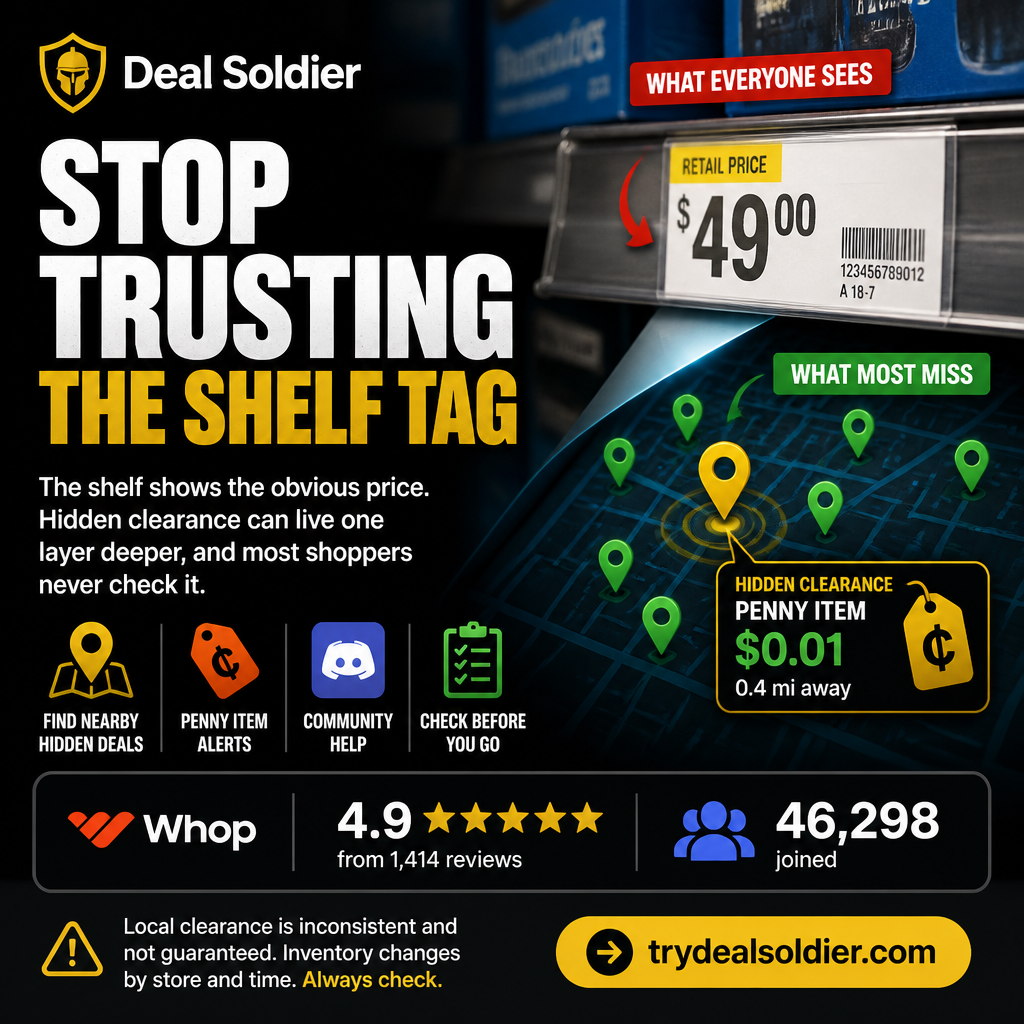
If you are fighting using one store's rules everywhere, use this operational test: the best store is the one where you can verify quickly and use the inventory, not the store with the loudest screenshots
Start the Deal Soldier 7-day trial on Whop
The Field Investigation: What We Are Actually Testing
If you are investigating Deal Soldier, you have likely seen viral social clips: shopping carts loaded with $25 laptops, $3 designer rugs, and penny clearance finds in big-box stores. But viral posts skip the operational friction: store inventory algorithms, shelf tagging lag, phantom stock, and the reality of resale fees.
The core trap we are deconstructing in this guide is using one store's rules everywhere. The operational rule of thumb is straightforward: the best store is the one where you can verify quickly and use the inventory, not the store with the loudest screenshots. If you cannot establish a systematic local workflow that produces verified savings during your 7-day free trial, you should cancel immediately on Whop.
Below is our complete field investigation for Walmart vs Target vs Home Depot vs Lowes: Best Stores For Hidden Clearance, broken down scene-by-scene into store mechanics, algorithm breakdowns, and actionable testing protocols.
Why Store Fit Matters
One of the most frequent mistakes novice clearance hunters make is assuming that all big-box retailers operate identically. They learn how Walmart yellow stickers work and expect Target to follow the same rules, or they try to apply Home Depot penny-hunting tactics inside a Lowe's.
In reality, each retail giant operates on completely distinct operational algorithms. Walmart relies on sheer volume, high-velocity seasonal rollbacks, and massive supercenter floorplans where items can remain lost for months.
Target operates on a rigid departmental weekday schedule with clean, orderly clearance endcaps. Home Depot utilizes a strict numerical price-ending progression leading to terminal salvage write-offs, while Lowe's balances corporate clearance with aggressive store-level manager discounts. Understanding which store matches your personal goals is essential.
| Retail Chain | Primary Clearance Strength | Primary Operational Friction | Best Suited For |
|---|---|---|---|
| Walmart | Massive volume; deepest unstickered discounts | Disorganized shelves; high phantom inventory | Aggressive hunters & high-volume resellers |
| Target | Predictable weekday schedules; high-end home/toys | Faster clearance sweeps; visible endcap tags | Beginners, parents, and household shoppers |
| Home Depot | Predictable .06 -> .03 -> .01 penny progression | Salvage items pulled by morning staff | DIYers, contractors, and penny deal hunters |
| Lowe's | High-ticket power tools & outdoor equipment | Manual associate price overrides required occasionally | Tool flippers and home renovators |
📋 Actionable Verification Protocol
- Identify which of the Big 4 retailers are located within your regular driving zone.
- Match your primary deal objective (household savings vs tool flipping) to the right store.
- Focus on mastering ONE retail chain's pricing quirks before expanding to others.
Target Decision: Choose your primary retail hunting targets based on your specific inventory goals.
Action Threshold: Select stores located within 15 minutes of your daily commuting corridors.
Immediate Failure Mode: Applying the wrong retailer tactics to the wrong store and wasting hours of effort.
For additional context on Why Store Fit Matters, compare this operational step with our detailed breakdown in Walmart Hidden Clearance Guide and cross-reference our field rules in Is Deal Soldier Good For Beginners?.
Walmart
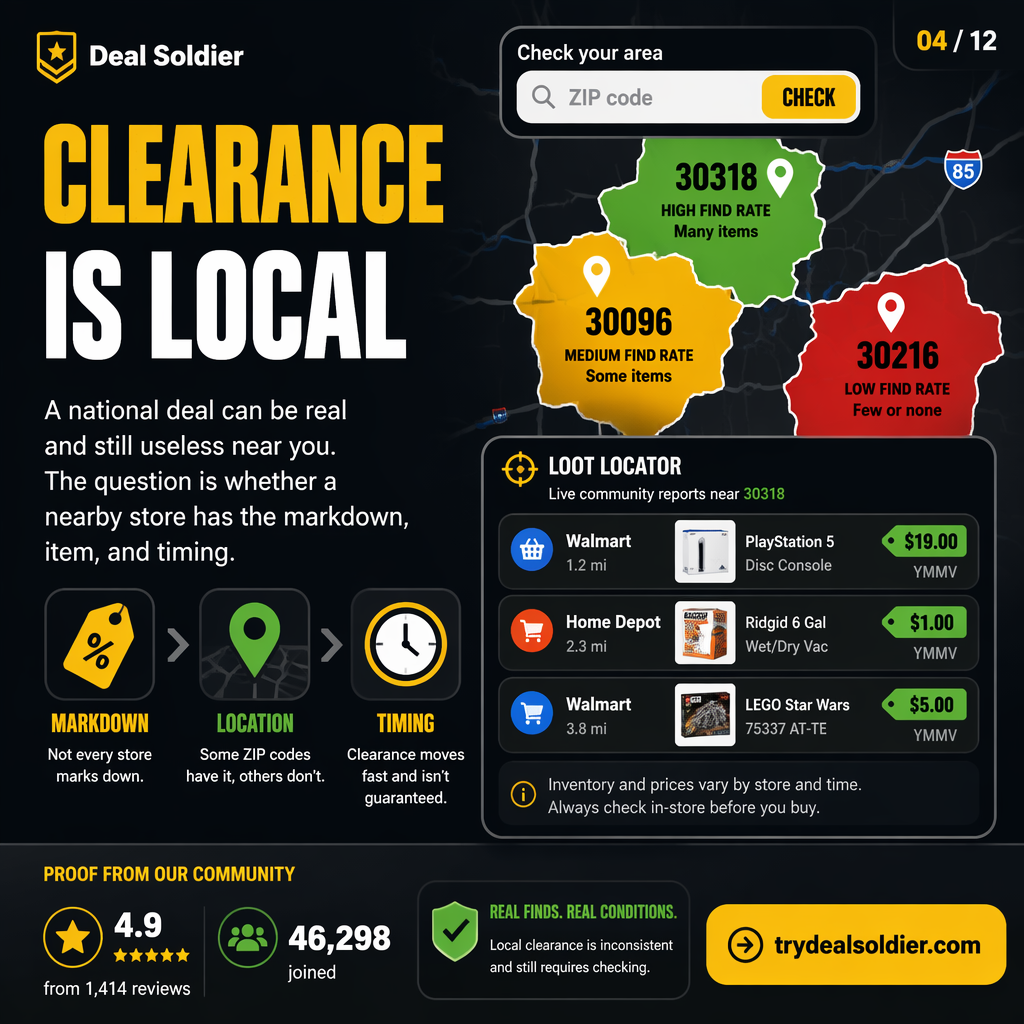
Walmart is the largest brick-and-mortar retailer in the world, and its clearance ecosystem is unrivaled in sheer scale. A typical Supercenter carries over 120,000 distinct SKUs, generating thousands of automated price changes every single week.
Walmart's central Home Office in Bentonville pushes major markdown batches during the first week of every month and during seasonal transitions (post-Christmas, spring garden reset, back-to-school). Because floor staffing is notoriously thin, there is often a massive 24 to 72-hour lag between the digital price drop and the physical application of yellow clearance stickers.
During this window, unstickered items sit on standard retail shelves or high top-stock storage risers. Scanning barcodes with the in-store Walmart app (connected to store Wi-Fi) or using Deal Soldier's Turbo Search reveals discounts of 70% to 90% that everyday shoppers walk right past.
| Walmart Markdown Cycle | Corporate Timing | Key Target Departments | Hunter Action |
|---|---|---|---|
| First-of-Month Purge | First 5 business days of the month | Electronics, Toys, Small Appliances | Scan seasonal transition aisles early morning |
| Mid-Month Sweep | 15th - 18th of the month | Apparel, Home Decor, Automotive | Check endcaps and bottom kickplates |
| Seasonal Clearance Tier 1 | Day 1 - 7 post-holiday | Holiday decor, seasonal garden, summer | 50% off register drops; high shelf stock |
| Seasonal Clearance Tier 2 | Day 8 - 14 post-holiday | Remaining seasonal inventory | 75% - 90% off drops; sweep remaining units |
📋 Actionable Verification Protocol
- Connect to Walmart's in-store Wi-Fi network to force your mobile app into in-store POS mode.
- Scan boxes on high top-stock risers above mainline displays in electronics and toys.
- Use self-checkout lanes to purchase unstickered clearance items smoothly.
Target Decision: Make Walmart your primary volume target for seasonal and unstickered clearance hauls.
Action Threshold: Target Walmart stores during the first week of the month for peak markdown volume.
Immediate Failure Mode: Relying solely on the designated clearance aisle, which casual shoppers pick clean.
For additional context on Walmart, compare this operational step with our detailed breakdown in Home Depot Penny Deals: Signal Or Time Sink? and cross-reference our field rules in Is Deal Soldier Good For Resellers?.
Target
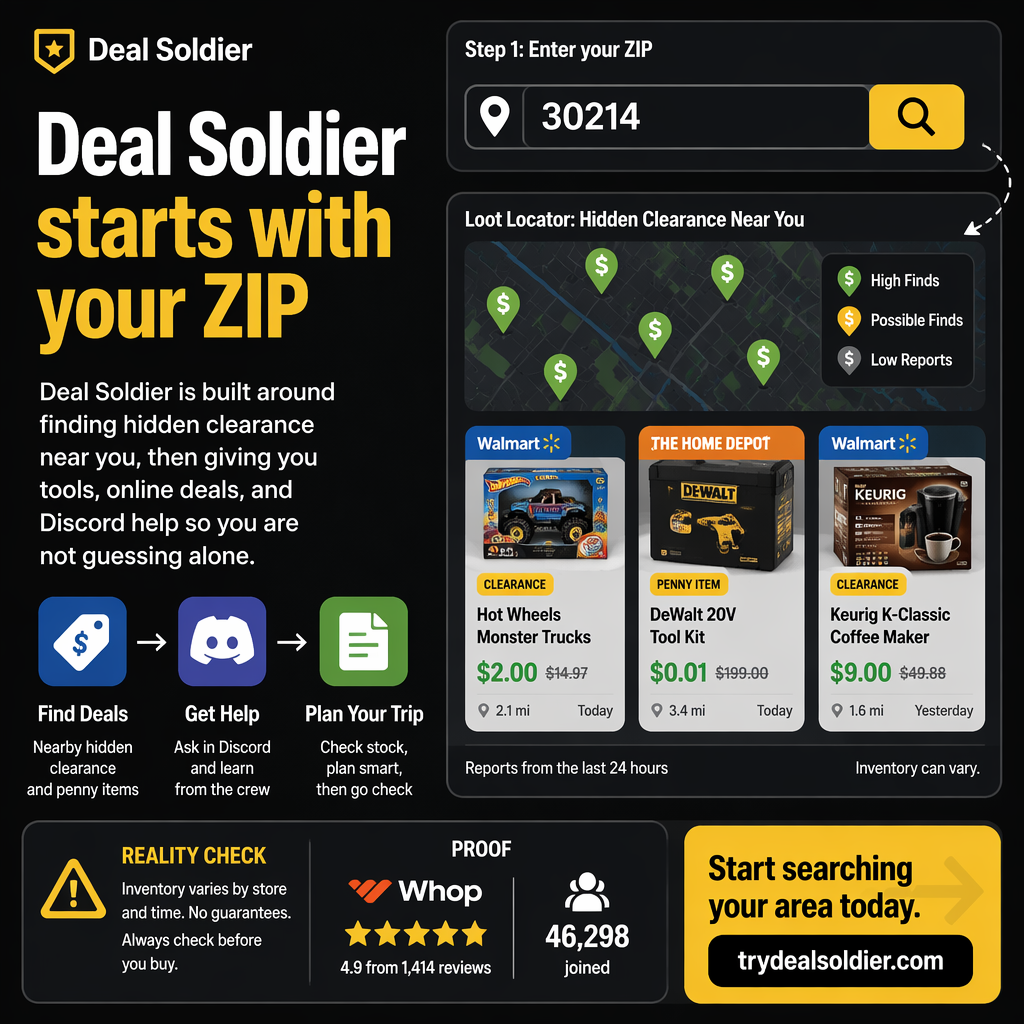
Target offers an entirely different clearance hunting experience than Walmart. Where Walmart is chaotic and sprawling, Target is organized, structured, and predictable.
Target marks down items along a standardized percentage ladder: first 30% off, then 50% off, and finally 70% off (with rare salvage drops reaching 90% on seasonal goods). Look at the tiny yellow clearance tag affixed to the item: the number in the top right corner indicates the exact percentage discount (e.g., '30', '50', '70').
Even more valuable is Target's departmental weekday schedule. Store markdown teams sweep specific departments on designated days of the week: Electronics on Monday, Women's Clothing and Pets on Tuesday, Men's and Toys on Wednesday, Home and Shoes on Thursday, and Hardware, Auto, and Beauty on Friday.
| Weekday | Target Markdown Departments | Clearance Tag Location | Hunter Strategy |
|---|---|---|---|
| Monday | Electronics, Kids Clothing, Books, Baby | Back endcaps of electronics aisles | Target high-end tech & baby monitors |
| Tuesday | Women's Apparel, Pets, Domestics, Grocery | Perimeter clothing racks & pet aisles | High-volume household essentials |
| Wednesday | Men's Apparel, Toys, Health & Beauty, Garden | Toy aisle endcaps facing outer walls | Prime day for toy flippers & parents |
| Thursday | Home Decor, Shoes, Luggage, Kitchen | Home aisle endcaps (yellow shelf strips) | Cookware & small appliances |
| Friday | Hardware, Automotive, Sporting Goods, Cosmetics | Hardware endcaps & cosmetic towers | Tools, car accessories, beauty sets |
📋 Actionable Verification Protocol
- Target specific departments on their designated markdown weekday morning.
- Check the top-right corner of yellow stickers to confirm the current discount tier (30, 50, 70).
- Inspect the rear endcaps of aisles facing the back perimeter wall for consolidated clearance.
Target Decision: Schedule your Target store visits around their departmental weekday markdown calendar.
Action Threshold: Wait for 70% off stickers on general merchandise; buy 50% on high-demand toys.
Immediate Failure Mode: Visiting on the wrong weekday when your target department has not been marked down.
For additional context on Target, compare this operational step with our detailed breakdown in Is Deal Soldier Good For Beginners? and cross-reference our field rules in Walmart Hidden Clearance Guide.
Home Depot
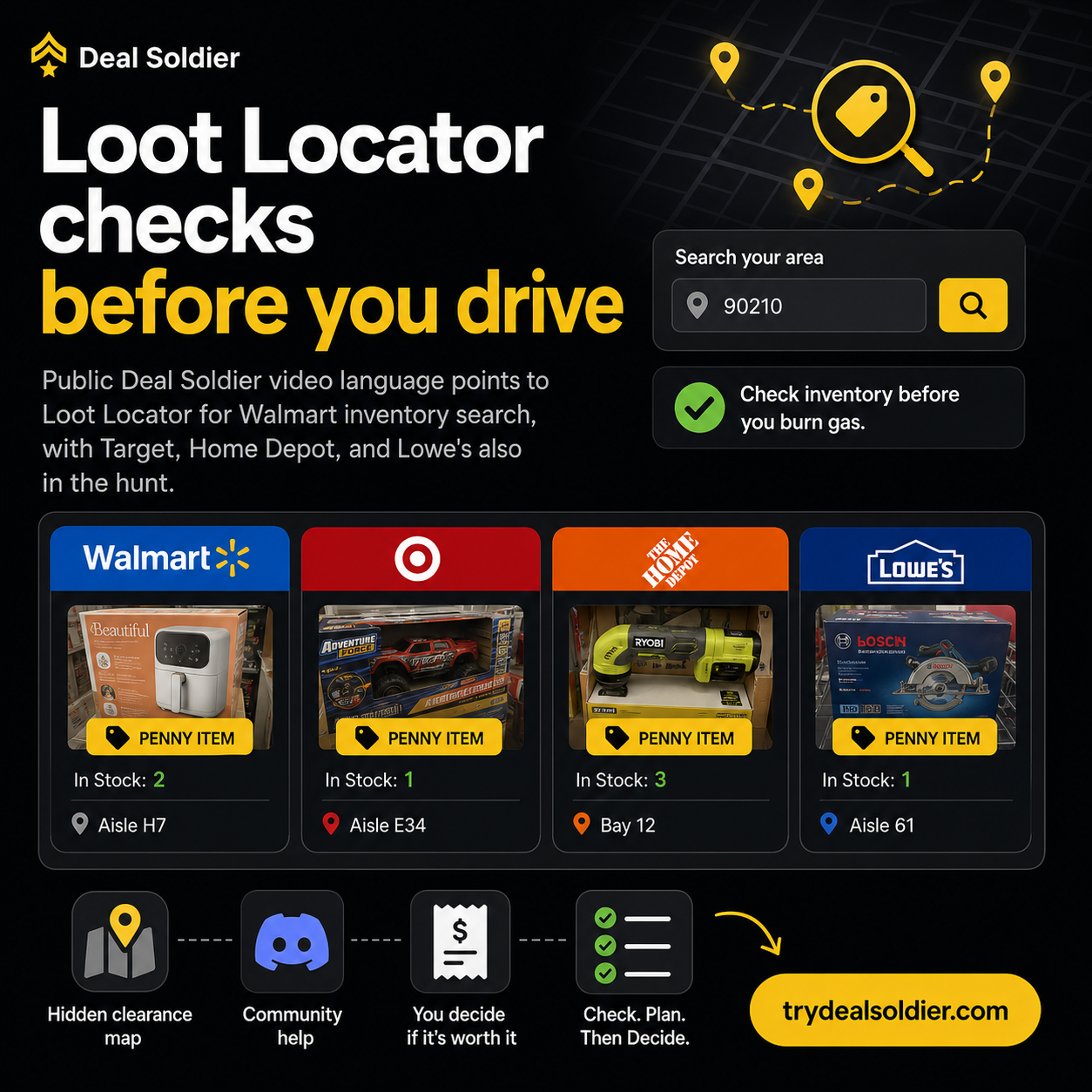
Home Depot is the holy grail for hardware hunters, contractors, and penny deal enthusiasts. Unlike general merchandise retailers, Home Depot's clearance pricing follows a strict, publicly documented numerical code.
When an item is discontinued, it receives a yellow clearance sticker ending in '.06' (representing initial clearance, roughly 33% off). It remains at this price for approximately six weeks. If it does not sell, the system drops the price to an ending of '.03' (roughly 75% off).
Approximately 21 days after hitting '.03', the corporate computer system drops the price to $0.01. At this stage, the item is classified as 'RTV' (Return to Vendor) or 'Salvage'. Store associates are tasked with pulling penny items from the floor, but in a 100,000-square-foot warehouse, dozens of penny items remain on shelves and ring up for $0.01 at self-checkout.
| Price Ending | Discount Level | Status in Store System | Hunter Strategy |
|---|---|---|---|
| Ending in .06 (e.g. $19.06) | ~33% off retail | Active sales floor clearance | Track item; record date printed on tag |
| Ending in .03 (e.g. $6.03) | ~75% off retail | Final clearance markdown | Buy if needed, or track 21-day penny countdown |
| Ending in .01 ($0.01) | Salvage write-off ($0.01) | Corporate disposal / recall flag | Immediate self-checkout purchase if on floor |
📋 Actionable Verification Protocol
- Inspect the small date code printed on the bottom corner of yellow clearance tags.
- Mark your calendar for 21 days after an item receives a .03 yellow sticker.
- Scan candidate penny items early in the morning at self-checkout lanes.
Target Decision: Track the .06 -> .03 -> .01 progression to capture high-ticket hardware for pennies.
Action Threshold: Target hardware, lighting, electrical, and plumbing aisles for consistent penny drops.
Immediate Failure Mode: Asking associates for assistance with penny items, which triggers immediate removal.
For additional context on Home Depot, compare this operational step with our detailed breakdown in Is Deal Soldier Good For Resellers? and cross-reference our field rules in Home Depot Penny Deals: Signal Or Time Sink?.
Lowes
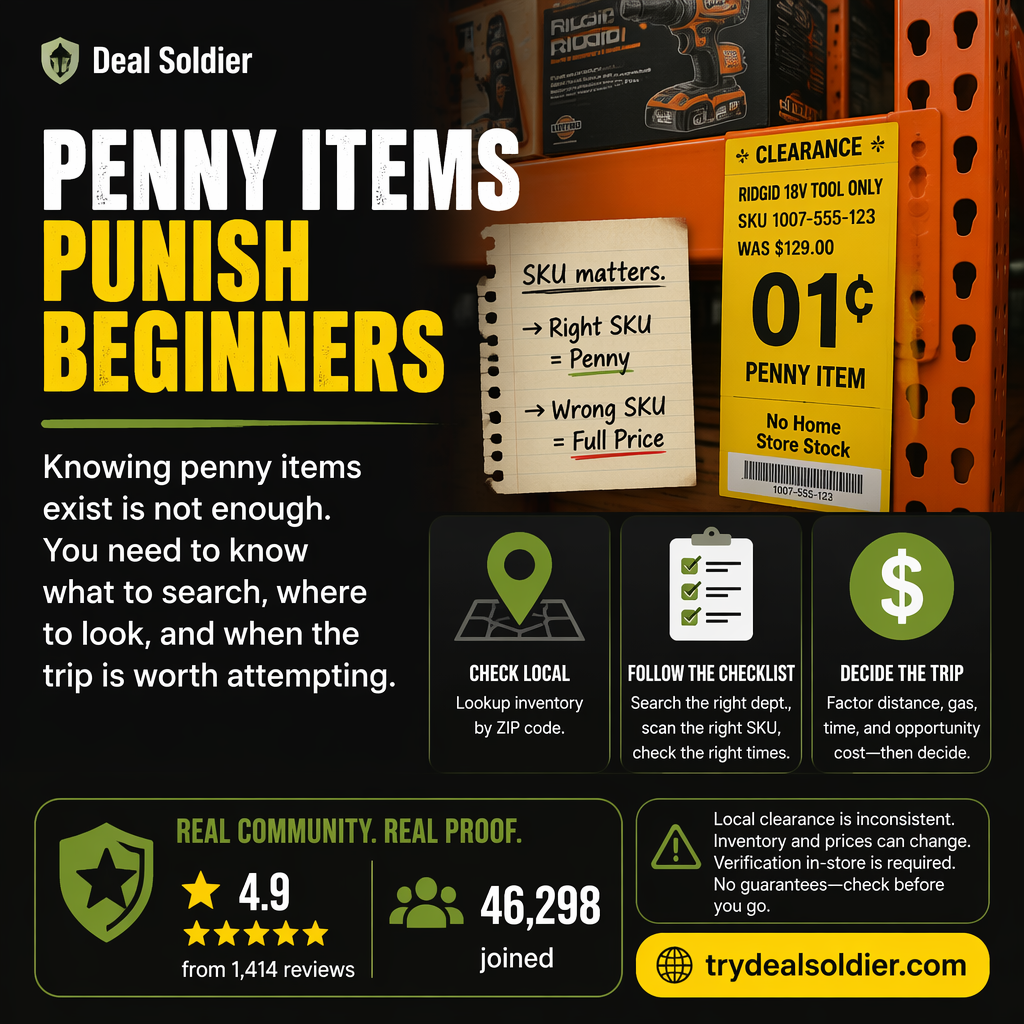
Lowe's is frequently overlooked by clearance hunters who obsess over Home Depot's penny deals. This is a massive mistake. Lowe's offers some of the most lucrative, clean clearance opportunities in retail, particularly in high-ticket categories like outdoor power equipment, cordless tools, and patio furniture.
Lowe's clearance tags generally end in '.97' or '.00'. Unlike Home Depot, Lowe's store managers possess broad autonomy to negotiate or slash prices on open-box goods, floor models, returned equipment, and seasonal merchandise that is occupying floor space.
Furthermore, Lowe's clearance items are often clustered together in designated 'Clearance Bays' at the front or back of the store, as well as integrated into mainline tool corrals. Deal Soldier's Turbo Search monitors Lowe's inventory feeds, allowing members to spot massive power tool markdowns before regional contractors clear them out.
| Lowe's Pricing Clue | Meaning | Typical Discount | Negotiation Potential |
|---|---|---|---|
| Price Ending in .97 | Corporate clearance markdown | 20% - 50% off MSRP | Fixed corporate price; no negotiation |
| Price Ending in .00 | Store manager final liquidation | 60% - 85% off MSRP | Store specific; immediate purchase recommended |
| Open-Box / Damaged Box Tag | Floor return or cosmetic box damage | 30% - 70% off MSRP | Highly negotiable with department manager |
📋 Actionable Verification Protocol
- Inspect the main clearance bay located near the lumber entrance and outdoor garden center.
- Check for prices ending in .00, which indicate aggressive store-level manager write-downs.
- Politely ask the department manager if they can take an additional 10-20% off open-box goods.
Target Decision: Target Lowe's for high-ticket power tools, lawn care equipment, and open-box hardware.
Action Threshold: Prioritize items marked with .00 price endings for maximum percentage savings.
Immediate Failure Mode: Assuming Lowe's has penny deals and wasting time searching for one-cent items.
For additional context on Lowes, compare this operational step with our detailed breakdown in Walmart Hidden Clearance Guide and cross-reference our field rules in Is Deal Soldier Good For Beginners?.
Beginners
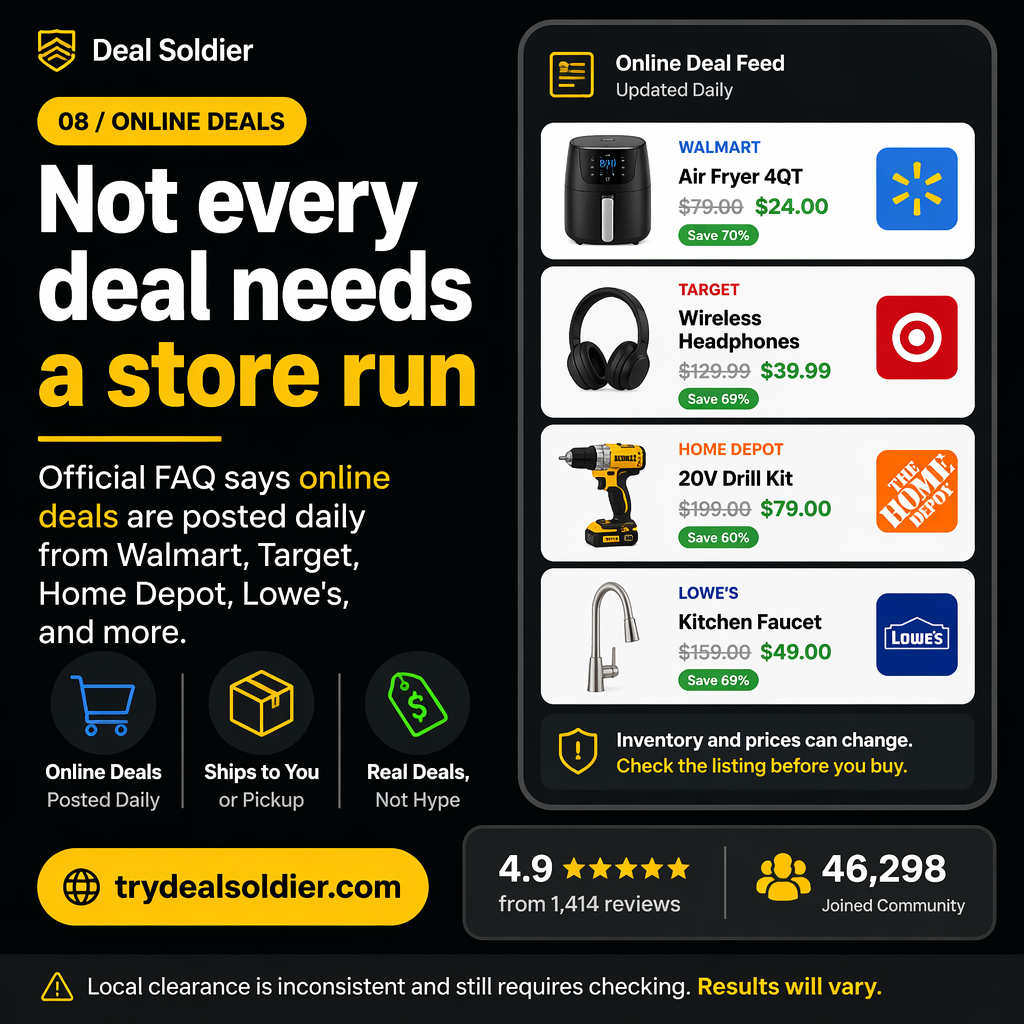
For someone who has never hunted clearance deals before, walking into a massive, disorganized Walmart Supercenter or an intimidating commercial Home Depot warehouse can feel overwhelming. Aisles are crowded, shelves are messy, and cashier policies can feel unpredictable.
The best store for beginners is unequivocally Target. Target stores are well-lit, organized, and clean. Their clearance tags clearly display the exact percentage discount (30, 50, 70) in plain numbers, eliminating guesswork.
By visiting Target on designated markdown mornings (e.g., Wednesday for toys, Thursday for home goods), a beginner can quickly learn the rhythm of retail clearance: scanning barcodes, reading shelf tags, verifying prices on their phone, and checking out smoothly without awkward friction.
| Store Feature | Target (Beginner Friendly) | Walmart (Advanced) |
|---|---|---|
| Store Cleanliness | Very clean, organized, wide aisles | Often chaotic, cluttered, freight on floor |
| Clearance Labeling | Clear yellow stickers showing exact % (30/50/70) | Yellow stickers frequently fall off or are unprinted |
| Checkout Experience | Smooth, fast, modern self-checkouts | Frequent register freezes, long lines, associate friction |
| Stress Level | Low; pleasant shopping environment | Moderate to high; intense competition |
📋 Actionable Verification Protocol
- Pick one Target store within 15 minutes of your house for your initial trial test runs.
- Visit on Wednesday or Thursday morning between 9:00 AM and 11:00 AM.
- Focus on finding 3 items at 70% off in toys or home goods to build scanning confidence.
Target Decision: Start your clearance journey at Target to master the fundamentals in a low-friction environment.
Action Threshold: Complete 3 successful Target shopping runs before attempting complex Walmart sweeps.
Immediate Failure Mode: Getting overwhelmed and discouraged by starting in high-chaos urban Walmart stores.
For additional context on Beginners, compare this operational step with our detailed breakdown in Home Depot Penny Deals: Signal Or Time Sink? and cross-reference our field rules in Is Deal Soldier Good For Resellers?.
Resellers
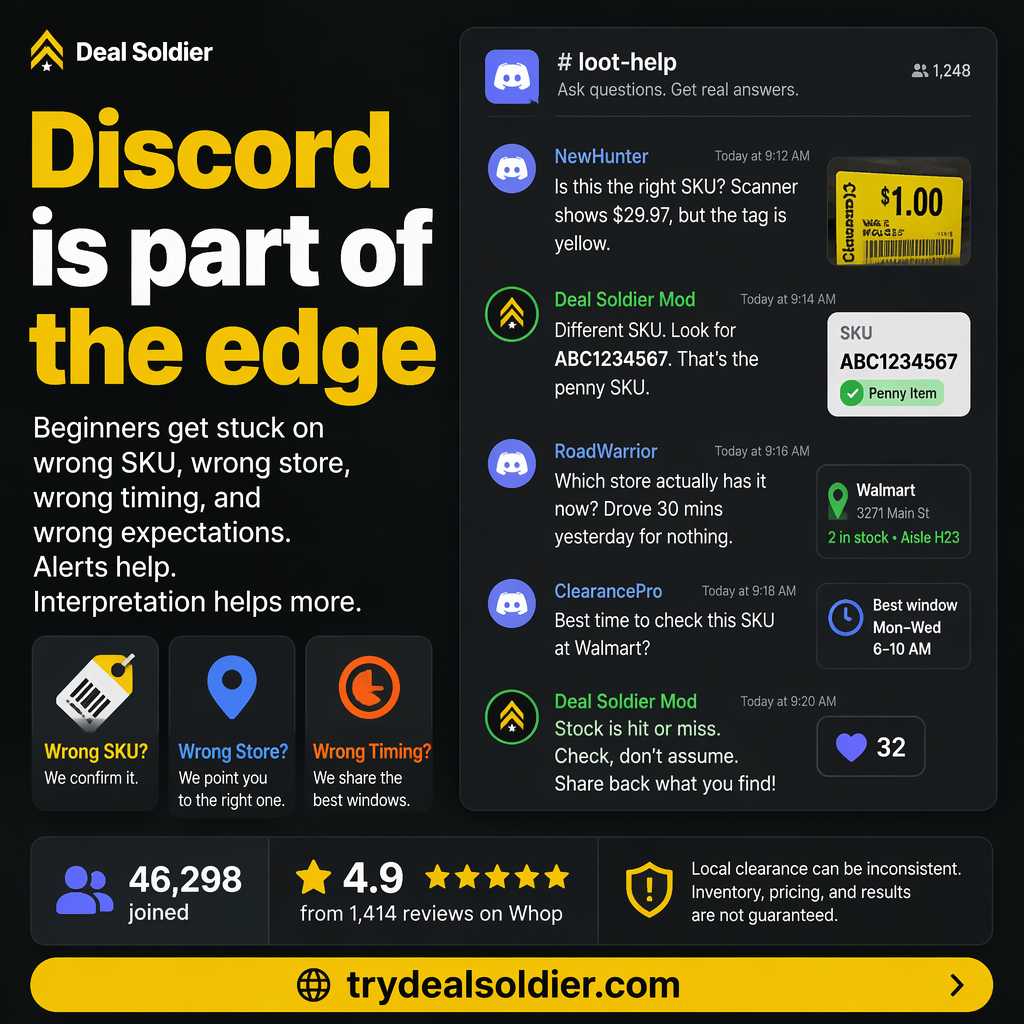
While Target is fantastic for beginners and household shoppers, commercial resellers require two things: inventory depth (multiples of the same SKU) and high-demand commercial brands. Target rarely holds more than 2 to 3 units of a clearance item, making scalable listing difficult.
Walmart and Home Depot are the workhorses of the professional retail reseller. A Walmart Supercenter might carry 20 units of a seasonal clearance power inverter or smart camera system. Buying all 20 units allows a reseller to create a single eBay listing with multi-quantity inventory, dramatically lowering labor time per unit sold.
Similarly, Home Depot carries top-tier commercial tool brands—DeWalt, Milwaukee, Makita, Rigid—that possess massive secondary market liquidity. A contractor or handyman on eBay will buy a clearance Milwaukee tool within 48 hours if priced competitively. For resellers, Walmart and Home Depot provide the volume and brand power needed to generate thousands in monthly net profit.
| Reseller Dimension | Target | Walmart & Home Depot |
|---|---|---|
| Inventory Depth Per SKU | 1 - 3 units (hard to scale listings) | 5 - 20+ units (bulk multi-quantity listings) |
| Brand Secondary Demand | Private label / retail brands (Threshold, etc.) | National power brands (DeWalt, Milwaukee, Apple) |
| Resale Liquidity | Moderate; steady seasonal demand | Ultra-High; daily secondary transaction volume |
| Profit Scalability | Low - Medium ($200 - $500 / month) | High - Extreme ($1,000 - $5,000+ / month) |
📋 Actionable Verification Protocol
- Focus 70% of your sourcing hours on Walmart Supercenters and Home Depot stores.
- Prioritize multi-unit purchases where a single listing covers 5+ identical items.
- Use Deal Soldier's SniperX to track national tool and electronics brand drops.
Target Decision: Anchor your resale sourcing pipeline around Walmart and Home Depot for maximum scalability.
Action Threshold: Target clearance lots with at least 4 identical units to minimize photography and listing labor.
Immediate Failure Mode: Wasting sourcing hours in low-inventory boutique retailers that cannot supply resale volume.
For additional context on Resellers, compare this operational step with our detailed breakdown in Is Deal Soldier Good For Beginners? and cross-reference our field rules in Walmart Hidden Clearance Guide.
Penny Hunters
Penny deal hunting is the most competitive, high-velocity subdiscipline in the clearance world. Buying $150 designer hardware, smart thermostats, or heavy-duty extension cords for literally $0.01 is as close to free money as retail gets.
However, penny deals carry a strict operational window. Because a penny price is an internal corporate flag indicating that the item must be pulled and destroyed, store associates are given daily 'RTV Salvage Lists' every morning. Associates walk their aisles with rolling carts, locate the items, and wheel them to the backroom claims cage.
To succeed as a penny hunter, you must be in the store when the doors unlock at 6:00 AM. By heading straight to the bays where you tracked .03 items reaching their 21-day maturity, you can find the merchandise on the sales floor and scan it at self-checkout before employees begin their morning disposal rounds.
| Time of Day | Associate Salvage Status | Penny Availability on Shelf | Hunter Outcome |
|---|---|---|---|
| 06:00 AM - 07:30 AM | Associates clocking in; morning meetings | 100% of unworked penny items still on floor | Prime window: Highest haul success |
| 07:30 AM - 10:00 AM | Floor associates executing RTV salvage lists | Rapidly declining as carts clear shelves | Moderate: Catching items associates missed |
| 10:00 AM - Close | Salvage sweeps completed; items in backroom cage | Near 0% (only hidden/lost boxes remain) | Extremely low: Near total waste of travel time |
📋 Actionable Verification Protocol
- Set your alarm for 5:30 AM on mornings when tracked penny drops mature.
- Arrive at Home Depot at 6:00 AM door-opening time.
- Take items directly to self-checkout registers to complete transactions smoothly.
Target Decision: Execute penny hunting exclusively during the early morning 6:00 AM to 7:30 AM window.
Action Threshold: Arrive within 60 minutes of store opening for all confirmed penny drop targets.
Immediate Failure Mode: Arriving in the afternoon and finding that store staff cleared all salvage merchandise.
For additional context on Penny Hunters, compare this operational step with our detailed breakdown in Is Deal Soldier Good For Resellers? and cross-reference our field rules in Home Depot Penny Deals: Signal Or Time Sink?.
Store Fit Matrix
To maximize your return on time invested, you must align your deal hunting strategy with the retail chain that best suits your goals. Sourcing across four different retailers without focus leads to scattered results and wasted travel.
Use the Store Fit Matrix below to review the four major big-box chains side-by-side across key operational dimensions: discount depth, inventory volume, scheduling predictability, and cashier friction.
Choose one primary retailer as your home base (accounting for 70% of your hunting time) and one secondary retailer for opportunistic seasonal drops.
| Retail Chain | Discount Depth | Inventory Volume | Schedule Predictability | Ease of Checkout | Best Hunter Match |
|---|---|---|---|---|---|
| Walmart | Extreme (70% - 90%) | Massive (Supercenters) | Moderate (1st week of month) | Moderate (Self-checkout best) | Active Resellers & Volume Hunters |
| Target | High (30% - 70%) | Moderate (1-3 units/SKU) | High (Strict weekday calendar) | Very Easy (Fast & friendly) | Beginners & Household Shoppers |
| Home Depot | Terminal ($0.01 penny) | High (Warehouse format) | High (.06 -> .03 -> .01 progression) | Moderate (Use self-checkout) | Contractors & Penny Hunters |
| Lowe's | Deep (.00 liquidation) | Moderate - High | Moderate (Store manager driven) | Easy - Moderate | Tool Flippers & DIY Renovators |
📋 Actionable Verification Protocol
- Identify your top retail match from the matrix above.
- Plan your weekly shopping schedule around that retailer's peak markdown days.
- Configure Deal Soldier's Turbo Search and SniperX to prioritize your primary store.
Target Decision: Specialize in the retail chain that matches your personal schedule and financial goals.
Action Threshold: Dedicate 70% of your weekly hunting time to your single best-fit retailer.
Immediate Failure Mode: Spreading yourself too thin across multiple retailers without mastering any.
For additional context on Store Fit Matrix, compare this operational step with our detailed breakdown in Walmart Hidden Clearance Guide and cross-reference our field rules in Is Deal Soldier Good For Beginners?.
FAQ
While Walmart, Target, Home Depot, and Lowe's represent the core of the clearance hunting world, questions frequently arise regarding other retailers, cashier etiquette, and tool requirements.
First: What about stores like TJ Maxx, Ross, or Ollie's Bargain Outlet? These stores are 'closeout liquidation retailers'—their entire inventory is already discounted. However, they do have seasonal yellow-tag clearance cycles where prices drop to $0.50 or $1.00. While lucrative, they lack public inventory APIs, making automated tools like Turbo Search ineffective. They require 100% manual in-store footwork.
Second: What is the golden rule of cashier etiquette? Never argue with a retail employee over a clearance price. If an item rings up higher than you expected, or an associate refuses to sell an unstickered or penny item, simply smile, say 'No problem, thank you so much', and leave the item. There will always be more deals, and maintaining a polite, professional reputation protects your long-term access.
| Question | Store Reality | Best Practice |
|---|---|---|
| Can I hunt Macy's or Kohl's? | Yes, but requires manual foot scanning | Focus 80% on Big 4 for automated tooling support |
| What if a self-checkout freezes? | Associate will scan badge to approve item | Remain calm and patient; do not act nervous |
| Do store return policies differ? | Walmart (90d), Target (90d), HD (90d), Lowe's (90d) | Keep digital receipts in your retailer mobile accounts |
| Can I use coupons on clearance? | Manufacturer coupons are accepted on clearance at Walmart/Target | Stack coupons with clearance for free / moneymaker hauls |
📋 Actionable Verification Protocol
- Download all four retailer apps (Walmart, Target, Home Depot, Lowe's) to your phone.
- Link your payment cards to store accounts for automatic digital receipt storage.
- Always treat store associates with professional courtesy and respect.
Target Decision: Master the Big 4 retail ecosystems while maintaining immaculate store etiquette.
Action Threshold: Review retailer return policies before buying large quantities of clearance goods.
Immediate Failure Mode: Arguing with store employees over salvage write-offs, risking store trespass.
For additional context on FAQ, compare this operational step with our detailed breakdown in Home Depot Penny Deals: Signal Or Time Sink? and cross-reference our field rules in Is Deal Soldier Good For Resellers?.